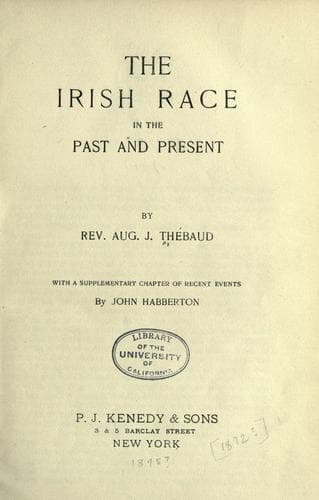
The Irish Race in the Past and the PresentThébaud, Augustus J.
History
The Irish Race in the Past and the Present
Thébaud, Augustus J.
Ireland -- History
Instances of such extreme cruelty are rare, even in the Acts of
the early martyrs, but they meet us every moment in the memoirs
of the days of Elizabeth. Both the police-spies and the soldier-
police were animated with the rage and fury which must have
possessed the soul of the queen herself; for, after all, the
cruelty practised in her reign, and mostly under her orders, was
not necessary in order to secure her throne to her, during life;
and, as she could hope for no posterity of her own, it was not
the desire of retaining the crown to her children which could
excuse so much bloodshed and suffering. She evidently followed
the promptings of a cruel heart in those atrocious measures
which constitute the feature of the home policy of her reign.
The persecution which raged incessantly throughout her long
career, in Ireland and England, is surely one of the most bloody
in the annals of the Catholic Church.
CHAPTER X.
ENGLAND PREPARED FOR THE RECEPTION OF PROTESTANTISM--IRELAND NOT.
It cost Elizabeth the greater part of her reign in time, and all
the growing resources of a united England in material, to
establish her spiritual supremacy in Ireland; and yet, when, at
her death, Mountjoy received orders to conclude peace on
honorable terms with the Ulster chieftains, her darling policy
was abandoned; and failure, in fact, confessed.
On the 30th of March, 1603, Hugh O'Neill and Mountjoy met by
appointment at Mellifont Abbey, where the terms of peace were
exchanged. O'Neill, having declared his submission, was granted
amnesty for the past, restored to his rank, notwithstanding his
attainder and outlawry, and reinstated in his dignity of Earl of
Tyrone. Himself and his people were to enjoy the "full and free
exercise of their religion;" new letters-patent were issued
restoring to him and other northern chieftains almost the whole
of the lands occupied by their respective clans.
O'Neill, on his part, was to renounce forever his title of
"O'Neill," and allow English law to prevail in his territory.
How this last condition could agree with the full and free
exercise of the Catholic religion, the treaty did not explain;
but it is evident that the new acts of Parliament respecting
religion were not to be included in the English law admitted by
the Ulster chiefs.
Meanwhile, the descendants of Strongbow's companions had been
completely subdued in the south, Munster having been devastated,
and the Geraldines utterly destroyed. Yet, even there,
Protestantism was not acknowledged by such of the inhabitants as
were left.
It may be well to compare here the different results which
attended the declaration of the queen's supremacy in England and
Ireland:
Public-domain text, read in full here on John Shaqi.
Reviews
Reviews
No reviews yet
Be the first to share your thoughts on this work.
Elsewhere in the archive
Join the Discussion
Join the discussion
Sign in to leave a comment or review.
Sign InorCreate an account