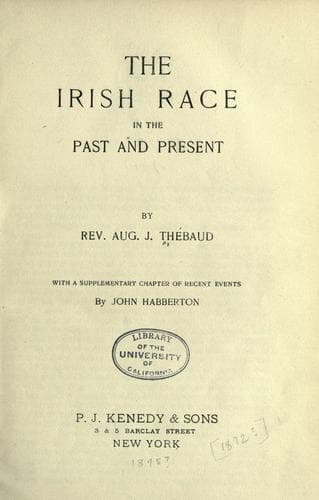
The Irish Race in the Past and the PresentThébaud, Augustus J.
History
The Irish Race in the Past and the Present
Thébaud, Augustus J.
Ireland -- History
At the commencement of Elizabeth's reign, England was still,
outwardly at least, as Catholic as Ireland. Henry VIII. had only
aimed at starting a schism; the Protestantism established under
Edward had been completely swept away during Mary's short reign.
Could Elizabeth only have hoped to be acknowledged queen by the
Pope, there can be little doubt that, even for political motives,
she would have refrained from disturbing the peace of the
country for the sake of introducing heresy. Religion was nothing
to her--the crown every thing.
It was not so easy a matter for her to establish heresy as for
Henry to introduce schism. All the bishops of Henry's reign,
with the exception of Fisher, had renounced their allegiance to
Rome, in order to please the sovereign; all the bishops of
Mary's nomination remained faithful to Rome; and so difficult
was it to find somebody who should consecrate the new prelates
created by Elizabeth, that Catholic writers have, we believe,
shown beyond question that no one of the intruding prelates was
really consecrated.
Nevertheless, at the end of Elizabeth's reign, there is no doubt
that the English people, with a few individual exceptions, were
Protestant; and Protestants they have ever since remained.
In Dr. Madden's "History of the Penal Laws," we read "Father
Campian was betrayed by one of Walsingham's spies, George Eliot,
and found secreted in the house of Mr. Yates, of Lyford, in
Berkshire, along with two other priests, Messrs. Ford and
Collington. Eliot and his officers made a show of their
prisoners to the multitude, and the sight of the priests in the
hands of the constables was a matter of mockery to the unwise
multitude. This was a frequent occurrence in conveying captured
priests from one jail to another, or from London to Oxford, or
vice versa, and it would seem, instead of finding sympathy from
the populace, they met with contumely, insult, and sometimes
even brutal violence. This is singular, and not easily accounted
for; of the fact, there can be no doubt."
Dr. Madden probably considered that, within a few years after
the change of religion, the English people ought to have shown
themselves as firm Catholics as did the Irish. But the
explanation of the contumely and violence is easy: it was an
English and not an Irish populace. The first had altogether
forgotten the faith of their childhood, the second could not be
brought to forsake it. The difficulty, in accounting for the
difference between them, is in getting at its true cause; and to
us it seems that one of the chief causes was the difference of
race.
Public-domain text, read in full here on John Shaqi.
Reviews
Reviews
No reviews yet
Be the first to share your thoughts on this work.
Elsewhere in the archive
Join the Discussion
Join the discussion
Sign in to leave a comment or review.
Sign InorCreate an account