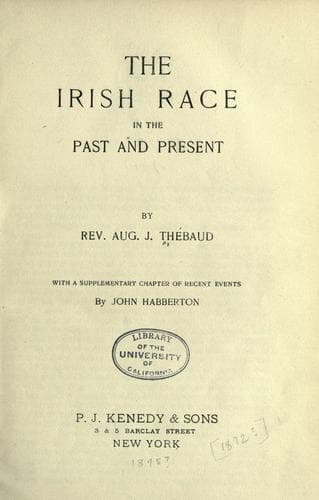
The Irish Race in the Past and the PresentThébaud, Augustus J.
History
The Irish Race in the Past and the Present
Thébaud, Augustus J.
Ireland -- History
But this remnant of affection for the religion of their fathers
seems to have soon died out, since at the death of Edward the
people appeared to have become thoroughly converted to the new
doctrines. At the very coronation of Mary, a Catholic clergyman
having prayed for the dead and denounced the persecutions of the
previous reign, a tumult took place; the preacher was insulted,
and compelled to leave the pulpit. What wonder, then, that, at
the death of Elizabeth, England was thoroughly Protestant?
We are very far from ignoring the noble examples of attachment
to their religion displayed by Christian heroes of every class
in England during those disastrous days. The touching
biographies of the English martyrs, told in the simple pages of
Bishop Challoner, cannot be read without admiration. The feeling
produced on the Catholic reader is precisely that arising from a
perusal of the Acts of the Christian martyrs under the Roman
emperors, which have so often strengthened our faith and drawn
tears of sorrow from our eyes. At this moment, particularly when
so many details, hitherto hidden, of the lives of Catholics,
religious, secular priests, laymen, women, during those times,
are coming to light in manuscripts religiously preserved by
private families, and at last being published for the
edification of all, the story is moving as well as inspiring of
the heroism displayed by them, not only on the public scaffold,
but in obscure and loathsome jails, in retreats and painful
seclusion, continuing during long years of an obscure life, and
ending only in a more obscure death, when the victim of
persecution was fortunate enough to escape capture. There is no
doubt that, when the whole story of the hunted Catholics in
England shall be known, as moving a narrative of their virtues
will be written as can be furnished by the ecclesiastical annals
of any people.
Nevertheless, what has been said of the nation, as a nation,
remains a sad fact which cannot be doubted. Those noble
exceptions only prove that the promptings of race are not
supreme, and that God's grace can exalt human nature from
whatever level.
How different were the nations of the Latin and Celtic stock!
With them the attachment to the religion of their fathers was
not the exception, but the rule, and it is only necessary to
bear in mind what the Abbe McGeoghegan has said--that, at the
death of Elizabeth, scarcely sixty Irishmen, take them all in
all, had professed the new doctrines--in order at once to
comprehend the steady tendency toward the path of duty imparted
by true nobility of blood. Nor did the Irish stand alone in this
steadfastness; it is needless to call to mind how the people
generally throughout France, and particularly in Paris, acted at
the time when the Huguenot noblemen would have rooted in the
soil the errors planted there before, and already bearing fruit
in Germany, Switzerland, and England.
Public-domain text, read in full here on John Shaqi.
Reviews
Reviews
No reviews yet
Be the first to share your thoughts on this work.
Elsewhere in the archive
Join the Discussion
Join the discussion
Sign in to leave a comment or review.
Sign InorCreate an account