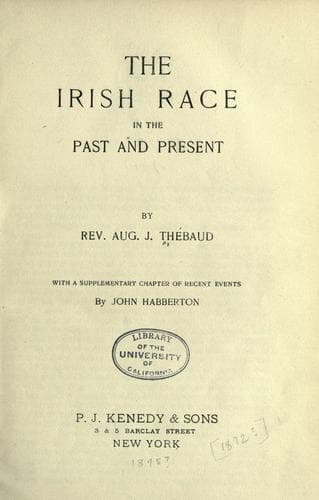
The Irish Race in the Past and the PresentThébaud, Augustus J.
History
The Irish Race in the Past and the Present
Thébaud, Augustus J.
Ireland -- History
The nation, also, in the main, sided with the kings against the
popes. Every burgher of London, York, or Canterbury, got it into
his head that Rome had formed deep designs of spoliation against
his private property, and purposed diving deep into his private
purse. In such a state of public opinion, respect for spiritual
authority could not fail to diminish and finally die out
altogether; and, when the voice of the Pontiff was heard on
important subjects in which the best interests of the nation
were involved, even the clearest proof that Rome was right, and
desired only the good of the people, could not entirely dispel
the suspicious fears and distrusts which must ever lurk in the
mind of the miser against those he imagines wish to rob him.
It is not possible to enter here into further details, but, if
the reader wish for stronger proofs of the "questioning spirit,"
"reasoning mistrust," and "systematic doggedness," natural to
the Scandinavian mind, he has only to reflect on what took place
in England at the time of the Reformation. Every question
respecting the soul, every supernatural aspiration of the
Christian, every emotion of a living conscience, appears to be
altogether absent from all those English nobles, prelates,
theologians, learned university men, even simple priests and
monks often, save a very few who, with the noble Thomas More,
thought that "twenty years of an easy life could not without
folly be compared with an eternity of bliss." The reasoning
faculty of the mind, nourished on "speculations," had replaced
faith, and, every thing of the supernatural order being
obliterated, nothing was left but worldly wisdom and material
aspirations for temporal well-being.
By reviewing other characteristics of the Scandinavian race, we
might arrive at the same conclusion; but our space forbids us to
go into them. After what has been said, however, it is easy to
see how well prepared was the English nation for accepting the
change of religion almost without a murmur.
There was, indeed, some expression of indignation on the part of
the people at the beginning of the reign of Edward VI., when the
desecration of the churches began. "Various commotions," says Dr.
Madden, "took place in consequence of the reviling of the
sacrament, the casting it out of the churches in some places,
the tearing down of altars and images; in one of which tumults,
one of the authorities was stabbed, in the act of demolishing
some objects of veneration in a church.
"The whole kingdom, in short, was in commotion, but particularly
Devonshire and Norfolk. In the former county, the insurgents
besieged Devon; a noble lord was sent against them, and, being,
reenforced by the Walloons--a set of German mercenaries brought
over to enable the government to carry out their plans--his
lordship defeated these insurgents, and many were executed by
martial law."
Public-domain text, read in full here on John Shaqi.
Reviews
Reviews
No reviews yet
Be the first to share your thoughts on this work.
Elsewhere in the archive
Join the Discussion
Join the discussion
Sign in to leave a comment or review.
Sign InorCreate an account