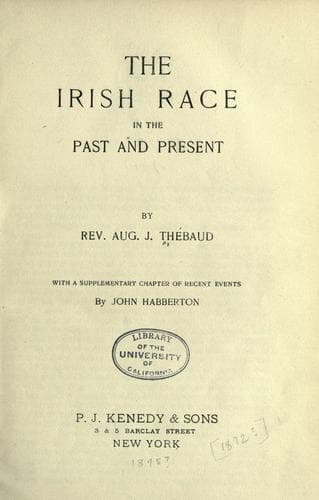
The Irish Race in the Past and the PresentThébaud, Augustus J.
History
The Irish Race in the Past and the Present
Thébaud, Augustus J.
Ireland -- History
Who can mention English freedom in the same breath with Henry
and Elizabeth Tudor? How could the actions of those two members
of the family advance it in the least degree, and was it not
precisely the slavish disposition of the English people at the
time which prepared them so admirably for the reception of
German heresy? The people were treated like a set of slaves, and
stood for nothing in the designs of those great political rulers.
In the very highest of the aristocracy, there lingered not a
spark of the old brave spirit which wrung Magna Charta from the
heart of a weak sovereign. The king or queen could fearlessly
trample on every privilege of the nobility, send the proudest
lords of the nation to the block, almost without trial, and
confiscate to the swelling of the royal purse the immense
estates of the first English families. There is no need of
proofs for this. The proofs are the records, the headings, as it
were, of the history of the times which one may read as he runs;
it constitutes the very essence of their history; and events of
the sixteenth century in England scarcely present us with any
thing else. This state of things was the natural result of the
general anarchy which prevailed during the "Wars of the Roses."
A more interesting and intricate question still might be raised
here: how to explain the appearance of such a phenomenon in so
proud a nation? Had the Catholic religion, which, up to that
time, had been the only religion of the country, anything to do
with the matter? These questions might furnish material for a
very animated discussion. But, with regard to the fact itself--
the slavish disposition of Englishmen at that time under kingly
and queenly rule--no doubt can possibly exist.
To show that Catholicity had nothing to do with the introduction
of such a despotism, would give rise to a dissertation too long
for us to enter upon. We merely offer a few suggestions, which,
we think, will prove sufficient and satisfactory for our purpose
to every candid reader:
I. Catholic theology had certainly never brought about such a
state of affairs. In all Catholic schools of the day, in England
as on the Continent, St. Thomas was the great authority, and his
work, "De Regimine Principum," was in the hands of all Catholic
students. Luther was the first to reject St. Thomas.
In this book, all were taught that, if, among the various kinds
of government, "that of a king is best," in the opinion of the
author, "that of a tyrant is the worst." And a tyrant he defines
as "any ruler who despises the common good, and seeks his
private advantage."
Public-domain text, read in full here on John Shaqi.
Reviews
Reviews
No reviews yet
Be the first to share your thoughts on this work.
Elsewhere in the archive
Join the Discussion
Join the discussion
Sign in to leave a comment or review.
Sign InorCreate an account