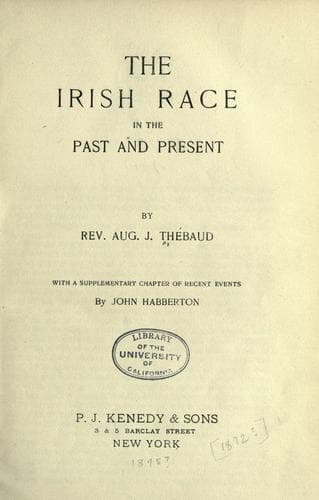
The Irish Race in the Past and the PresentThébaud, Augustus J.
History
The Irish Race in the Past and the Present
Thébaud, Augustus J.
Ireland -- History
In that book of the great doctor, all may read: "The farther the
government recedes from the common weal, the more unjust is it.
It recedes farther from the common weal in an oligarchy, in
which the welfare of a few is sought, than in a democracy, whose
object is the good of the many. . . . But farther still does it
recede from the common weal in a tyrannous government, by which
the good of one alone is sought."
The general consequence which St. Thomas draws from this
doctrine is, that, "if a ruler governs a multitude of freemen
for the common good of the multitude, the government will be
good and just as becomes freemen."
Such was the political doctrine taught in the Catholic
universities of Europe until the sixteenth century; but, in all
probability, this golden work, "De Regimine Principum," was no
longer the text-book in the English schools of the time of Henry
Tudor.
But, when, entering into details, the holy and learned author
goes on to contrast the contrary effects produced by freedom and
despotism on a nation, how could Henry willingly permit the
circulation of such words as the following?
"It is natural that men brought under terror" (a tyrannical
government) "should degenerate into beings of a slavish
disposition, and become timid and incapable of any manly and
daring enterprise--an assertion which is proved by the conduct
of countries which have been long subjected to a despotic
government. Solomon says: 'When the imperious are in power, men
hide away' in order to escape the cruelty of tyrants, nor is it
astonishing; for a man governing without law, and according to
his own caprice, differs in nothing from a beast of prey. Hence,
Solomon designates an impious ruler as a roaring lion and a
ravenous bear.'
"Because, therefore, the government of one is to be preferred --
which is the best--and because this government is liable to
degenerate into tyranny--which has been proved to be the worst --
hence, the most diligent care is to be taken so to regulate the
establishment of a king over the people, that he may not fall
into tyranny."
Finally, St. Thomas epitomizes the doctrines of this whole book
in his "Summa," as follows: "A tyrannical government is unjust,
being administered, not for the common good, but for the private
good of the ruler; therefore, its overthrow is not sedition,
unless when the subversion of tyranny is so inordinately pursued
that the multitude suffers more from its overthrow than from the
existence of the government."
The subject might be illustrated by any quantity of extracts
from the writings of other great theologians of the middle ages;
but what we have said is enough for our purpose. It is manifest
that Catholic doctrine cannot have brought about the state of
England under the Tudors.
II. Another, and a very important suggestion, is the following:
it certainly was not the Catholic hierarchy, least of all the
pontifical power, which produced it.
Public-domain text, read in full here on John Shaqi.
Reviews
Reviews
No reviews yet
Be the first to share your thoughts on this work.
Elsewhere in the archive
Join the Discussion
Join the discussion
Sign in to leave a comment or review.
Sign InorCreate an account