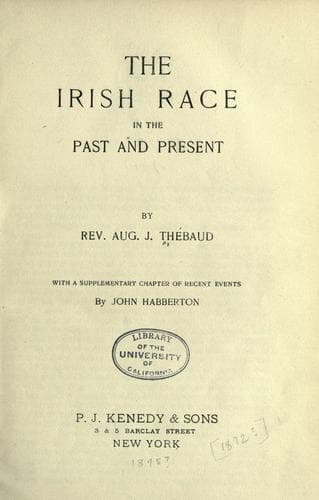
The Irish Race in the Past and the PresentThébaud, Augustus J.
History
The Irish Race in the Past and the Present
Thébaud, Augustus J.
Ireland -- History
If the question be merely one of refinement of outward manners,
and aquaintance with the artificial code established by a
society with which the Irish, up to that time, had never come in
contact, the Normans may be granted whatever benefit may accrue
to them from such, though, even here, the Irish chieftains might
later on compare favorably with their foes. For instance, if is
doubtful whether Hugh O'Donnell and O'Sullivan Beare, one of
whom went to Spain, and the other to Portugal--and the second,
Philip II. commanded to be treated as a Spanish grandee --were
not as courteous and dignified as Cecil or Walsingham, or Essex
or Raleigh, at the court of Elizabeth. And, if we take the case
of the descendants of Strongbow's warriors, who became "more
Irish than the Irish," there is no reason why we should not
prefer the manners and bearing of young Gerald Desmond, when,
after leaving Rome, he appeared at the court of Tuscany, to
those of the young lords who danced at Windsor, under the eyes
of Henry, with Anne Boleyn. But, treating the subject seriously,
and examining it more closely, we may find a necessity for
reversing the opinion which is too commonly entertained.
Civilization does not consist only, or chiefly, in refinement of
manners, but in all things which exalt a nation; and, after the
"conscience" of which we have spoken, nothing is so important in
making a nation civilized as the institutions under which it
lives.
The laws are the great index of a people's civilization, chiefly
as regards their execution. Nothing can be more indicative of it
than the criminal code of a people.
The law of England at that time compares poorly with the Irish
compilation known as the "Senchus Mor," which scholars have only
recently been able to study, and which is being printed as we
write, and to be illustrated with learned notes. From all
accounts given by competent reviewers, it is clear that wisdom,
sound judgment, equity, and Christian feeling, constitute the
essence of those laws which Edmund Campian found the young
Irishmen of his day studying under such strange circumstances
and with such ardor and application as to spend sixteen or
eighteen years at it.
And in what manner were those very Christian enactments which
lay at the foundation of the English legislation executed at the
same period? What, for instance, were the features of its
criminal code? It is unnecessary to depict what all the world
knows.
Public-domain text, read in full here on John Shaqi.
Reviews
Reviews
No reviews yet
Be the first to share your thoughts on this work.
Elsewhere in the archive
Join the Discussion
Join the discussion
Sign in to leave a comment or review.
Sign InorCreate an account