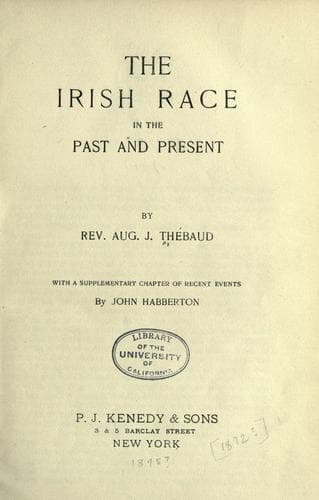
The Irish Race in the Past and the PresentThébaud, Augustus J.
History
The Irish Race in the Past and the Present
Thébaud, Augustus J.
Ireland -- History
Strange that such an obvious and common-sense remark had never
occurred to the intelligent and highly-civilized members of the
English Parliament--those ardent lovers of freedom--when applied
to by a new English monarch to acknowledge and confirm, as law,
the religious system he had determined to establish!
Apparently, then, at this time, Ireland possessed a conscience
which England either laid no claim on, or made no pretensions to;
and it might not be too much to lay this down as the first
reason why Ireland remained faithful to her religion. In fact,
the whole history of the period bears out this general
observation. The subserviency of the proud English aristocracy,
of those pretended statesmen and legislators, in matters so
intimately connected with the soul, its convictions and its
morality, shows conclusively that the word "conscience" had no
meaning for them, or that, if they were aware of the existence
of such a thing, they made so little account of it that they
were ready at all times to barter it for position, what they
considered honor, and wealth.
On the other hand, the constant, unshaken, and emphatic refusal
of the Irish to renounce their religion for the novel
"speculations" of pretended theologians-- in reality, heretical
teachers --at the beck of king or queen; their willingness to
submit to all the rigor of extreme penal laws rather than
disobey their sense of right, proves too well that they
possessed a conscience, knew what it meant, and resolved to
follow it. There is not a single fact of their, history, general
or particular, taking them collectively as a nation, when, by
their actions, they spoke as one people or individually, when
priest and friar, great man or mean man, chose to lose position,
property, name--life itself--rather than be false to their
religion and God--which does not prove that they owned a
conscience and obeyed its voice.
Can a nation, deprived of this, be esteemed really free and
truly civilized? and can a nation which possesses it be
considered barbarous? The answer cannot be doubtful, and is of
itself a sufficient solution of the question under examination.
But, to come to more special details. The Irish idea of
civilization was certainly of a very different character from
that of the English; but was it the less true? From the landing
of the first invasion, the Norman nobles and prelates looked
down on the invaded people as barbarous and uncouth, as they
previously looked down upon the Anglo-Saxons. Later on, they
spoke of the Irish customs as "lewd;" and, later still, the
majority of them adopted those "lewd customs."
Public-domain text, read in full here on John Shaqi.
Reviews
Reviews
No reviews yet
Be the first to share your thoughts on this work.
Elsewhere in the archive
Join the Discussion
Join the discussion
Sign in to leave a comment or review.
Sign InorCreate an account