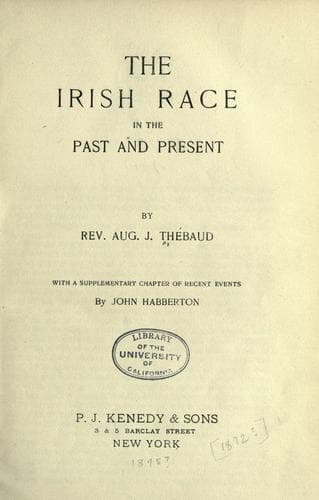
The Irish Race in the Past and the PresentThébaud, Augustus J.
History
The Irish Race in the Past and the Present
Thébaud, Augustus J.
Ireland -- History
3. Even had it entered into their minds to wish for a
reformation of some kind, they were certainly unprepared for the
one offered them. The first reform of the new order was to close
the religious houses which the people loved, which were the
seats of learning, holiness, and education. Their Catholic
ancestors had founded those religious houses; they themselves
enjoyed the spiritual and even temporal advantages attached to
them, for they constituted in fact the only important and useful
establishments which their country possessed; they had been
consecrated by the lives and deaths of a thousand saints within
their walls; and they suddenly beheld pretended ministers of a
new religion of which they knew nothing, backed by ferocious
Walloon or English troopers, turn out or slay their inmates,
close them, set them on fire, pillage them, or convert them into
private dwellings for the convenience of an imported aristocracy.
This was the first act of the "introduction " of the
"Reformation " into Ireland. The people were enabled to judge of
the sanctity of the new creed at its first appearance among them.
And this alone, apart from their firm adherence to the faith of
their fathers, was quite enough to justify them in their
resistance to such a substitute.
But, above all, when they beheld how the inmates of those holy-
houses were treated, when they saw them cast out into the world,
penniless, reduced to penury and want, persecuted, declared
outcasts, hunted down, insulted by the soldiery, arrested,
cruelly beaten, bound hand and foot, and hung up either before
the door of their burning monastery, or even in the church
itself before the altar--what wonder that they were unprepared
to receive the new religion?
The barbarity displayed throughout England and Ireland toward
Catholicism was specially fiendish when directed against
religious of both sexes; and, as in Ireland no class of persons
was more justly and dearly loved, what wonder that the Irish
literally hated the religion that came to them from beyond the
sea?
Without going over the other aspects of the religious question
of the time, and comparing article with article of the new and
old beliefs, this single feature of the case alone is sufficient.
The process might be carried out with advantage, but is not
necessary.
Public-domain text, read in full here on John Shaqi.
Reviews
Reviews
No reviews yet
Be the first to share your thoughts on this work.
Elsewhere in the archive
Join the Discussion
Join the discussion
Sign in to leave a comment or review.
Sign InorCreate an account