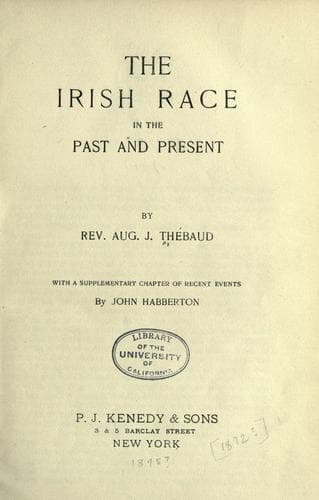
The Irish Race in the Past and the PresentThébaud, Augustus J.
History
The Irish Race in the Past and the Present
Thébaud, Augustus J.
Ireland -- History
4. The new order of things, in one word, resolved itself into
rapacity and wanton bloodshed. And, despite whatever may be said
of Irish outrages by those who are never tired of alluding to
them, Irish nature is opposed to such excesses. If they are ever
guilty of such, it is only when they have previously been
outraged themselves, and in such cases they are the first to
repent of their action in their cooler moments. On the other
hand, the men who first set all these outrages going never find
reason to accuse themselves of any thing, are even perfectly
satisfied with and convinced of their own perfection; and, as
from the first they acted coolly and systematically, their self-
equanimity is never disturbed, they continue unshaken in the
calm conviction that they have always been in the right,
whatever may have been the consequences of the initiative
movement and its steady continuance.
But we repeat advisedly--the Irish nature is opposed to rapacity
and wanton shedding of blood, and this formed another strong
reason for their opposition to the religious revolution which
immersed them in so bloody a baptism.
5. Yet perhaps the most radical and real cause of their
persistent refusal to embrace Protestantism lies in their
traditional spirit, of which we have previously spoken. There is
no rationalistic tendency in their character.
And all the points well considered, which, after all, is the
better, the simply traditional or strictly rationalistic nature?
What has been the result of those philosophical speculations
from which Protestantism sprang? Whither are men tending to-day
in consequence of it? Would it not have been better for mankind
to have stood by the time-honored traditions of former ages,
independently of the strong and convincing claims which
Catholicity offers to all? This is said without in the least
attributing the fault to sound philosophy, without casting the
slightest slur on those truly great and illustrious men who have
widened the limits of the human intellect, and deserved well of
mankind by the solid truths they have opened up in their works
for the benefit and instruction of minds less gifted than their
own.
CHAPTER XI.
THE IRISH AND THE STUARTS.--LOYALTY AND CONFISCATION.
Upon the death of Elizabeth, in 1603, the son of the unfortunate
Mary Stuart was called to the throne of England, and for the
first time in their history the Irish people accepted English
rule, gave their willing submission to an English dynasty, and
afterward displayed as great devotedness in supporting the
falling cause of their new monarchs, as in defending their
religion and nationality.
This feeling of allegiance, born so suddenly and strangely in
the Irish breast, cherished so ardently and at the price of so
many sacrifices, finally raising the nation to the highest pitch
of heroism, is worth studying and investigating its true cause.
Public-domain text, read in full here on John Shaqi.
Reviews
Reviews
No reviews yet
Be the first to share your thoughts on this work.
Elsewhere in the archive
Join the Discussion
Join the discussion
Sign in to leave a comment or review.
Sign InorCreate an account