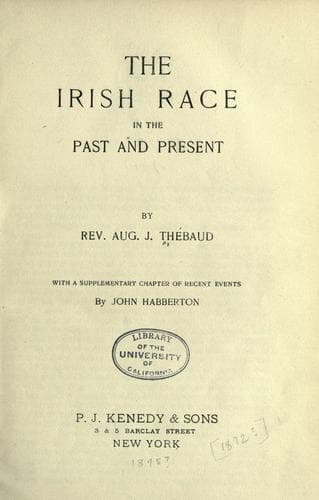
The Irish Race in the Past and the PresentThébaud, Augustus J.
History
The Irish Race in the Past and the Present
Thébaud, Augustus J.
Ireland -- History
What ought to have been the natural effect produced on the Irish
people by the arrival of the news that James of Scotland had
succeeded to Elizabeth? The first feeling must have been one of
deep relief that the hateful tyranny of the Tudors had passed
away, to be supplanted by the rule of their kinsmen the Stuarts--
kinsmen, because the Scottish line of kings was directly
descended from that Dal Riada colony which Ireland had sent so
long ago to the shores of Albania, to a branch of which
Columbkill belonged.
For those who were not sufficiently versed in antiquarian
genealogy to trace his descent so far back, the thought that
James was the son of Mary Stuart was sufficient. If any people
could sympathize with the ill-starred Queen of Scots, that
people was the Irish. It could not enter into their ideas that
the son of the murdered Catholic queen, should have feelings
uncongenial to their own. It is easy, then, to understand how,
when the news of Elizabeth's death and of the accession of James
arrived, the sanguine Irish heart leaped with a new hope and
joyful expectation.
As for the real disposition of that strangest of monarchs, James
I,, writers are at variance. Matthew O'Connor, the elder, who
had in his hands the books and manuscripts of Charles O'Connor
of Bellingary, is very positive in his assertions on his side of
the question:
"James was a determined and implacable enemy to the Catholic
religion; he alienated his professors from all attachment to his
government by the virulence of his antipathy. One of his first
gracious proclamations imported a general jail-delivery, except
for 'murderers and papists.' By another proclamation he pledged
himself 'never to grant any toleration to the Catholics,' and
entailed a curse on his posterity if they granted any."
Turning now to Dr. Madden's "History of the Penal Laws," we
shall feel disposed to modify so positive an opinion. There we
read:
"It is very evident that his zeal for the Protestant Church had
more to do with a hatred of the Puritans than of popery, and
that he had a hankering, after all, for the old religion which
his mother belonged to, and for which she had been persecuted by
the fanatics of Scotland."
Hume seems to support this judgment of Dr. Madden when he says
that "the principles of James would have led him to earnestly
desire a unity of faith of the Churches which had been separated."
Both opinions, however, agree in the long-run, since Dr. Madden
is obliged to confess that "new measures of severity, as the
bigotry of the times became urgent, were wrung from the timid
king. He had neither moral nor political courage."
Public-domain text, read in full here on John Shaqi.
Reviews
Reviews
No reviews yet
Be the first to share your thoughts on this work.
Elsewhere in the archive
Join the Discussion
Join the discussion
Sign in to leave a comment or review.
Sign InorCreate an account