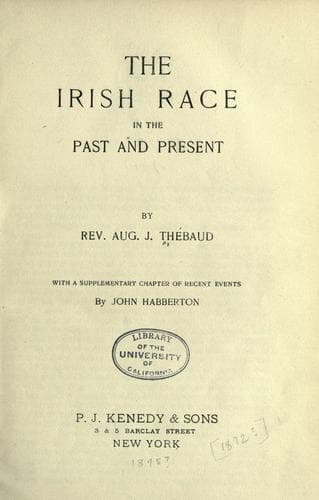
The Irish Race in the Past and the PresentThébaud, Augustus J.
History
The Irish Race in the Past and the Present
Thébaud, Augustus J.
Ireland -- History
The Tyrone war had ended five years before, and those who had
taken part in the conflict had already received their portion;
the vanquished, of misfortune--the conquerors, of gain. James
brought in with him from Scotland a host of greedy followers;
and all, from first to last, expected to rise with their king
into wealth and honor. England was not wide enough to hold them,
nor rich enough to satiate their appetites. The puzzled but
crafty king saw a way out of his difficulties in Ireland. He no
longer limited the distribution of land in that country to
soldiers and officers of rank chiefly. He gave it to Scotch
adventurers, to London trades companies. He settled it on
Protestant colonies whose first use of their power was to evict
the former tenants or clansmen, and thus effect a complete
change in the social aspect of the north.
Well did they accomplish the task assigned them. Ulster became a
Protestant colony, and the soil of that province has ever since
remained in the hands of a people alien to the country.
Yet the Ulstermen had been led to believe that James purposed
securing them in their possessions; for, according to Mr.
Prendergast, in his Introduction to the "Cromwellian settlement:"
"On the 17th of July, 1607, Sir Arthur Chichester, Lord Deputy,
accompanied by Sir John Davies and other commissioners,
proceeded to Ulster, with powers to inquire what land each man
held. There appeared before them, in each county they visited,
the chief lords and Irish gentlemen, the heads of creaghts, and
the common people, the Brehons and Shanachies, who knew all the
septs and families, and took upon themselves to tell what
quantity of land every man ought to have. They thus ascertained
and booked their several lands, and the Lord-Deputy promised
them estates in them. 'He thus,' says Sir John Davies, 'made it
a year of jubilee to the poor inhabitants, because every man was
to return to his own house, and be restored to his ancient
possessions, and they all went home rejoicing.'
"Notwithstanding these promises, the king, in the following year,
issued his scheme for the plantation of Ulster, urged to it, it
would seem, by Sir Arthur Chichester, who so largely profited by
it. . . . It could not be said that the flight of the earls gave
occasion for this change, inasmuch as the king, immediately
after, issued a proclamation--which he renewed on taking
possession of both earls' territories--assuring the inhabitants
that they should be protected and preserved in their estates."
Public-domain text, read in full here on John Shaqi.
Reviews
Reviews
No reviews yet
Be the first to share your thoughts on this work.
Elsewhere in the archive
Join the Discussion
Join the discussion
Sign in to leave a comment or review.
Sign InorCreate an account