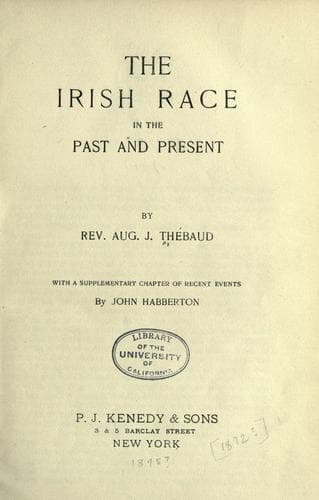
The Irish Race in the Past and the PresentThébaud, Augustus J.
History
The Irish Race in the Past and the Present
Thébaud, Augustus J.
Ireland -- History
It looks, indeed, as though the whole transaction, including the
promises and the call for ascertaining the quantity of land
occupied by each inhabitant, as also the sham plot into which
the earls were inveigled, was but a cunning device to bring
about the plantation, in which manors of one thousand, fifteen
hundred, and three thousand acres, were offered to such English
and Scotch as should undertake to plant their lots with British
Protestants, and engage that no Irish should dwell upon them.
Meanwhile, all who had been in arms during Tyrone's war were to
be transplanted with their families, cattle, and followers, to
waste places in Munster and Connaught, and there set down at a
distance from one another.
Over and above this, the Irish were indebted to James for a new
project--a most ingenious invention for successful plunder. He
was the real author of the celebrated "Commission for the
investigation of defective titles."
It would seem that the province of Ulster was too small for the
rapacity of those who were constantly urging upon the king a
greater thoroughness in his plans. It was clear, moreover, that
the English occupation of the other three provinces had hitherto
proved a failure. The island had failed to become Anglicised,
and it was necessary to begin the work anew.
The new commission was presented to the Irish people in a most
alluring guise. That political hypocrisy, which to-day stands
for statesmanship, is not a growth of our own times. The
intention of James confined itself to putting an end to all
uncertainty on the subject of titles, and bestowing on each land-
owner one which, for the future, should be unimpeachable. But
the result went beyond his intention. This measure became, in
fact, an engine of universal spoliation. It failed to secure
even those who succeeded in retaining a portion of their former
estates in possession, as Strafford made manifest, who, despite
all the unimpeachable titles conferred by James, managed to
confiscate to his own profit the greater part of the province of
Connaught.
It is fitting to give a few details of this new measure of James,
in order to show the gratitude which the Irish owed the Stuarts,
if on that account only. In "Ireland under English Rule," the
Rev. A. Perraud justly remarks: "Most Irish families held
possession of their lands but by tradition, and their rights
could not be proved by regular title-deeds. By royal command, a
general inquiry was instituted, and whoever could not prove his
right to the seat of his ancestors, by authentic documents, was
mercilessly but juridically despoiled of it; the pen of the lawyer
thus making as many conquests as the blade of the mercenary."
Public-domain text, read in full here on John Shaqi.
Reviews
Reviews
No reviews yet
Be the first to share your thoughts on this work.
Elsewhere in the archive
Join the Discussion
Join the discussion
Sign in to leave a comment or review.
Sign InorCreate an account