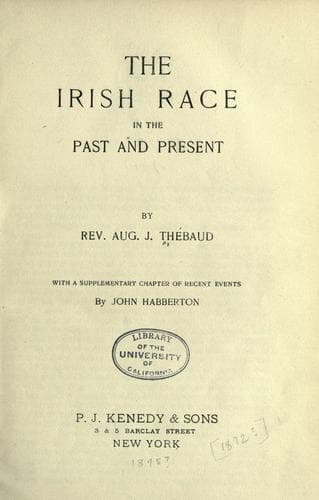
The Irish Race in the Past and the PresentThébaud, Augustus J.
History
The Irish Race in the Past and the Present
Thébaud, Augustus J.
Ireland -- History
With regard to the Anglo-Irish, and even such of the natives as
had consented to accept titles from the English kings, those
titles, some of which went back as far as Strongbow's invasion,
were brought under the "inquiry" of the new commission--with
what result may be imagined. An astute legist can discover flaws
in the best-drawn legal papers. In the eye of the law, the
neglect of recording is fatal; and it was proved that many
proprietors, whose titles had been bestowed by Henry VIII. and
Elizabeth, were not recorded, simply by bribing the clerks who
were charged with the office of recording them.
This portion of our subject must present strange features to
readers acquainted with the laws concerning property which
obtain among civilized nations. In making the necessary studies
for this most imperfect sketch, the writer has been surprised at
finding that not one of the authors whom he has consulted has
spoken of any thing beyond the cruelty of compelling Irish
landowners to exhibit title-deeds, which it was known they did
not and could not possess. Not a single one has ever said a word
of "prescription;" yet, this alone was enough to arrest the
proceedings of any English court, if it followed the rules of
law which govern civilized communities.
Most of the estates, then declared to be escheated to the king,
had been in possession of the families to which the holders
belonged, for centuries; we may go so far, in the case of some
Irish families and tribes, as to say for thousands of years. But,
to disturb property which has been held for even less than a
century, would convulse any nation subjected to such a revolutionary
process. No country in the world could stand such a test; it would
loosen in a day all the bonds that hold society together.
If the commission set on foot by James did not go to the extreme
lengths to which it was carried by those who came after him, he
it was who established what bore the semblance of a legal
precedent for the excesses of Strafford, under Charles I., which
reached their utmost limits in the hands of Cromwell's
parliamentary commissioners. James set the engine of destruction
in action: they worked it to its end. The Irish might justly lay
at his door all the woes which ensued to them from the
principles emanating from him. Even during his reign they saw,
with instinctive horror, the abyss which he had opened up to
swallow all their inheritance. The first commission of James
commenced its operations by reporting three hundred and eighty-
five thousand acres in Leinster alone as "discovered," inasmuch
as the titles "were not such as ought " (in their judgment) "to
stand in the way of his-Majesty's designs."
Public-domain text, read in full here on John Shaqi.
Reviews
Reviews
No reviews yet
Be the first to share your thoughts on this work.
Elsewhere in the archive
Join the Discussion
Join the discussion
Sign in to leave a comment or review.
Sign InorCreate an account