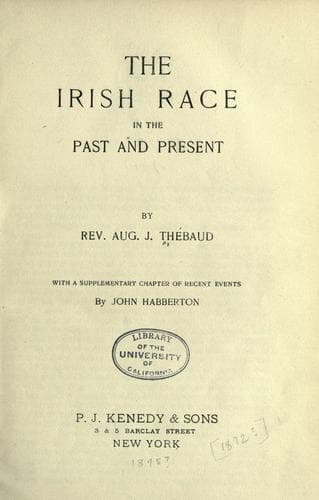
The Irish Race in the Past and the PresentThébaud, Augustus J.
History
The Irish Race in the Past and the Present
Thébaud, Augustus J.
Ireland -- History
Hence, long before the death of James, all the hopes which his
accession had raised in the minds of the Irish had vanished; yet,
strange to say, they were not cured of their love for the
Stuart dynasty. They hailed the coming of Charles, the husband
of a Catholic princess, with joy. His marriage took place a year
previous to the death of his father; and, to know that Henrietta
of France was to be their queen, was enough to assure the Irish
that, henceforth, they would enjoy the freedom of their religion.
The same motive always awakes in them hope and joy. Men may
smile at such an idea, but it is with a profound respect for the
Irish character that such a sentence is written. Hope of
religious freedom is the noblest sentiment which can move the
breast of man; and if there be reason for admiration in the
motive which urges men to fight and die for their firesides and
families, how much more so in that which causes them to set
above all their altars and their God!
This time their hope seemed well-founded; for the treaty
concluded between England and France conferred the right on the
Catholic princess of educating her children by this marriage
till the age of thirteen. And, in addition, conditions favorable
to the English Catholics were inserted in the same treaty.
But people were not then aware of the reason for the insertion
of those conditions. Hume, later on, being better acquainted
with what at the time was a secret, states in his history that
"the court of England always pretended, even in the memorials to
the French court, that all the conditions favorable to the
English Catholics were inserted in the marriage treaty merely to
please the Pope, and that their strict execution was, by an
agreement with France, secretly dispensed with."
The Irish rejoiced, however; and Charles and his ministers
encouraged their expectations. Lord Falkland, in the name of the
king, promised that, if the Catholic lords should present
Charles, who needed money, with a voluntary tribute, he would in
return grant them certain immunities and protections, which
acquired later on a great celebrity under the name of "graces."
The chief of these were--to allow "recusants" to practise in the
courts of law, and to sue out the livery of their land, merely
on taking an act of civil allegiance instead of the oath of
supremacy; that the claims of the crown should be limited to the
last sixty years--a period long enough in all conscience; and
that the inhabitants of Connaught should be allowed to make a
new enrolment of their estates, to be accepted by the king. A
Parliament was promised to sit in a short time, in order to
confirm all these "graces."
The subsidy promised by the Irish lords amounted to the then
enormous sum of forty thousand pounds sterling, to be paid
annually for three years. Two-thirds of it was paid, according
to Matthew O'Connor, but no one of the "graces" was forthcoming,
the king finding he had promised more than he could perform.
Public-domain text, read in full here on John Shaqi.
Reviews
Reviews
No reviews yet
Be the first to share your thoughts on this work.
Elsewhere in the archive
Join the Discussion
Join the discussion
Sign in to leave a comment or review.
Sign InorCreate an account