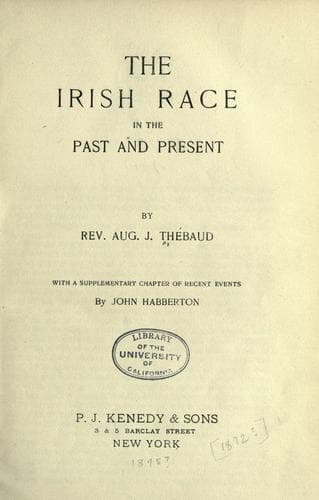
The Irish Race in the Past and the PresentThébaud, Augustus J.
History
The Irish Race in the Past and the Present
Thébaud, Augustus J.
Ireland -- History
The troops of Kennedy, son of Lorcan, are said to have been
supported by a fleet of fifty sail, commanded by Falvey Finn, a
Kerry chieftain. We need not repeat the story so well known to
all readers of Irish history. But this fact is found only in the
work of Keating, and the best critics accept it merely as an
historical romance, which Keating thought proper to insert in his
history. Still, even supposing the truth of the story, all that we
may conclude from it is that the seafaring Danes, at the end of
their long wars, had taught the Irish to use the sea as a battlefield,
to the extent of undertaking a small expedition in order to
liberate a beloved chieftain.
It is very remarkable, also, that according to the annals of Ireland,
the naval expeditions nearly always bore a religious character, never
one of trade or barter, with the exception of the tale of Brescan,
who was swallowed up with his fifty curraghs, in which he traded
between Ireland and Scotland.
Nearly all the other maritime excursions are voyages undertaken
with a Christian or Godlike object. Thus our holy religion was
carried over to Scotland and the Hebrides by Columbkill and his
brother monks, who evangelized those numerous groups of small
islands. Crossing in their skiffs, and planting the cross on
some far-seen rock or promontory, they perched their monastic
cells on the bold bluffs overlooking the ocean.
No more was the warrior on carnage bent to be seen on the seaboards
of Ulster or the western coast of Albania, as Scotland was then
called; only unarmed men dressed in humble monastic garb trod those
wave-beaten shores. At early morning they left the cove of their
convent; they spread their single sail, and plied their well-worn
oars, crossing from Colombsay to Iona, or from the harbor of Bangor
to the nearest shore of the Isle of Man.
At noon they may have met a brother in the middle of the strait
in his shell of a boat, bouncing over the water toward the point
they had left. And the holy sign of the cross passed from one
monk to the other, and the word of benison was carried through
the air, forward and back, and the heaven above was propitious,
and the wave below was obedient, while the hearts of the two
brothers were softened by holy feelings; and nothing in the air
around, on the dimly-visible shores, on the surface of the heaving
waves, was seen or heard save what might raise the soul to heaven
and the heart to God.
Public-domain text, read in full here on John Shaqi.
Reviews
Reviews
No reviews yet
Be the first to share your thoughts on this work.
Join the Discussion
Join the discussion
Sign in to leave a comment or review.
Sign InorCreate an account