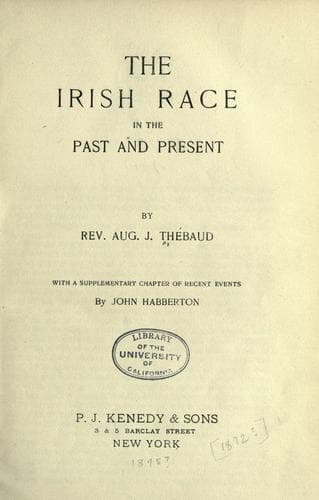
The Irish Race in the Past and the PresentThébaud, Augustus J.
History
The Irish Race in the Past and the Present
Thébaud, Augustus J.
Ireland -- History
Had Charles even then possessed the courage, honesty, or wisdom
to recognize and acknowledge his true friends, he might have
been spared the fate which overtook him; but all he did was
almost to break up the only coalition which stood up boldly in
his favor.
A circumstance not yet touched upon meets us here. Protestantism
was at this time effecting a complete change in the rules of
judgment and conduct which men had hitherto followed. In place
of the old principles of political morality which up to this
period had regulated the actions of Christians, notions of
independence, of subversion of existing governments, of
revolutions in Church and state, were for the first time in
Christian history scattered broadcast through the world, and
beginning that series of catastrophes which has made European
history since, and which is far from being exhausted yet. The
Irish stood firm by the old principles, and, though they became
victims to their fidelity, they never shrank from the
consequences of what they knew to be their duty, and to those
principles they remain faithful to-day.
To return from this short digression: The Irish hierarchy, the
native Irish and the Anglo-Irish lords of the Pale, had combined
together to form the "Confederation of Kilkenny," in which
confederation lay the germ of a truly great nation. Early in the
struggle the Catholic hierarchy saw that it was for them to take
the initiative in the movement, and they took it in right
earnest. They could not be impassive spectators when the
question at issue was the defence of the Catholic religion,
joined this time with the rights of their monarch. They met in
provincial synod at Kells, where, after mature deliberation, the
cause of the confederates, "God and the king," freedom of
worship and loyalty to the legitimate sovereign, was declared
just and holy, and, after lifting a warning voice against the
barbarities which had commenced on both sides, and ordaining the
abolition and oblivion of all distinctions between native Irish
and old English, they took measures for convoking a national
synod at Kilkenny.
It met on the 10th of May, 1643. An oath of association bound
all Catholics throughout the land. It was ordained that a
general assembly comprising all the lords spiritual and temporal
and the gentry should be held; that the assembly should select
members from its body to represent the different provinces and
principal cities, to be called the Supreme Council, which should
sit from day to day, dispense justice, appoint to offices, and
carry on the executive government of the country.
Public-domain text, read in full here on John Shaqi.
Reviews
Reviews
No reviews yet
Be the first to share your thoughts on this work.
Elsewhere in the archive
Join the Discussion
Join the discussion
Sign in to leave a comment or review.
Sign InorCreate an account