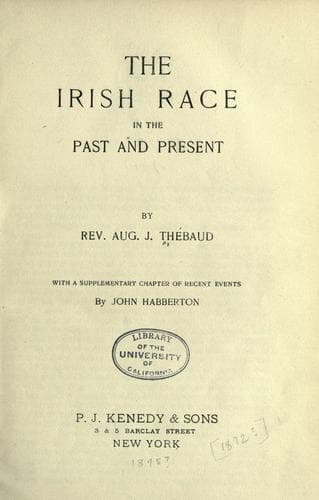
The Irish Race in the Past and the PresentThébaud, Augustus J.
History
The Irish Race in the Past and the Present
Thébaud, Augustus J.
Ireland -- History
Thus in the famous rising of 1641, when in one night Ireland,
with the exception of a few cities, freed herself from the
oppressor (the failure of the plan in Dublin being the only
thing which prevented a complete success; the English of the
Pale still refusing to combine with the Irish), the native Irish
alone, left to their own resources, proclaimed emphatically in
explicit terms their loyalty to the king, whom they credited
with a just and tolerant disposition, if freed from the
restraints imposed upon him by the Puritanical faction. A
further fact stranger still, and still more calculated to shake
their confidence in the monarch, occurred shortly after, which
indeed raises the loyalty of the nation to a height
inconceivable and impossible to any people, unless one whose
conscience is swayed by the sense of stern duty.
When the Scottish Covenanters, whose rebellion had secured them
in possession of all they demanded, heard of the Irish movement,
they were at once seized with a fanatical zeal urging them to
stamp out the Irish "Popish rebellion." King Charles, who was
then in Edinburgh, expressed his gratification at their proposal,
and no time was lost in shipping a force of two thousand Scots
across the Channel. They landed at Antrim, when they began those
frightful massacres which opened by driving into the sea three
thousand Irish inhabitants of the island Magee.
When, according to M. O'Connor's "Irish Catholics," "letters
conveying the news of the intended invasion of the Scots were
intercepted; when the speeches of leading members in the English
Commons, the declaration of the Irish Lord-Justices, and of the
principal members of the Dublin Council, countenanced those
rumors; when Mr. Pym gave out that he would not leave a Papist
in Ireland; when Sir Parsons declared that within a twelvemonth
not a Catholic should be seen in the whole country; when Sir
John Clotworthy affirmed that the conversion of the Papists was
to be effected with the Bible in one hand and the sword in the
other," and the King all the while seemed to allow and consent
to it, the Irish were not in the least dismayed by those rumors,
but set about establishing in the convulsed island a sort of
order in the name of God and the king!
Then for the first time did native and Anglo-Irish Catholics
take common side in a common cause. This was the union which
Archbishop Browne had foreseen, which had shown itself in
symptoms from time to time, but which had oftener been broken by
the old animosity. But, at last, convinced that the only party
on which they could rely, and the party which truly supported
the reigning dynasty, was that of the Ulster chiefs, the
Catholic lords of the Pale threw themselves heart and soul into
it, and, under the guidance of the Catholic bishops who then
came forward, together they formed the celebrated "Confederation
of Kilkenny" in 1642.
Public-domain text, read in full here on John Shaqi.
Reviews
Reviews
No reviews yet
Be the first to share your thoughts on this work.
Elsewhere in the archive
Join the Discussion
Join the discussion
Sign in to leave a comment or review.
Sign InorCreate an account