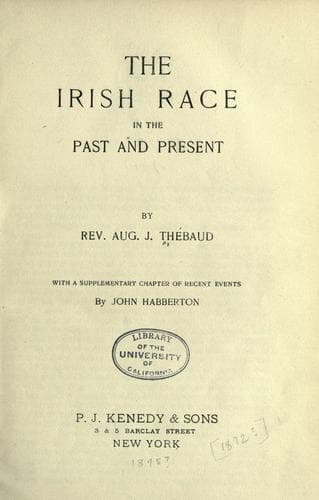
The Irish Race in the Past and the PresentThébaud, Augustus J.
History
The Irish Race in the Past and the Present
Thébaud, Augustus J.
Ireland -- History
There is no exaggeration in these expressions, as anybody must
concede who has studied the opinions and prejudices entertained
by the English with regard to the Irish, from that period down
almost to our own days. At any rate, to one acquainted with the
workings of the "Court of Wards," there is nothing surprising in
the fact that Ormond, the descendant of so many illustrious men
of the great Butler family--a family at all times so attached to
the Catholic faith, and which afterward furnished so many
victims to the transplantation schemes of Cromwell--should
himself become an inveterate enemy to the religion of his own
parents, and to those who professed it; and that he should
employ the great gifts which God had granted him, solely to
scheme against this religion, and prevent his native countrymen
from receiving even the scanty advantages which Charles at one
time was willing to concede to them, through Lord Glanmorgan.
It was Ormond who prevented the execution of the treaty between
that lord and the confederates, the provisions of which were--
1. The Catholics of Ireland were to enjoy the free and public
exercise of their religion.
2. They were to hold, and have secure for their use, all the
Catholic churches not then in actual possession of Protestants.
3. They were to be exempt from the jurisdiction of the
Protestant clergy.
But, thanks to his education, such provisions were too much for
Ormond, the son of a Catholic father, and whose mother, at the
very time living a pious and excellent life, would have rejoiced
to see those advantages secured to her Church and herself, in
common with the rest of her countrymen and women.
In like manner, Murrough O'Brien, the Baron of Inchiquin, the
descendant of so many Catholic kings and saints, whose name was
a glory in itself, and so closely linked to the Catholic glories
of the island, was converted, by the education which he had
received, into a most cruel oppressor of the Church of his
baptism. His expeditions, through the same country which his
ancestors had ruled, were characterized by all the barbarities
practised at the time by Munro, Coote, and all the parliamentary
leaders of the Scotch Puritans, and would have fitted him as a
worthy compeer of Cromwell and Ireton, who were soon to follow.
The name of Cashel and its cathedral, where he murdered so many
priests, women, and children, around the altar adorned by the
great and good Cormac McCullinan, would alone suffice to hand
his name down to the execration of posterity.
Public-domain text, read in full here on John Shaqi.
Reviews
Reviews
No reviews yet
Be the first to share your thoughts on this work.
Elsewhere in the archive
Join the Discussion
Join the discussion
Sign in to leave a comment or review.
Sign InorCreate an account