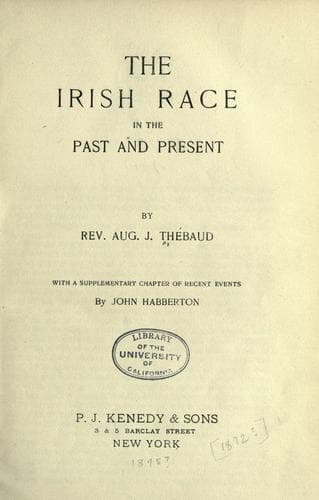
The Irish Race in the Past and the PresentThébaud, Augustus J.
History
The Irish Race in the Past and the Present
Thébaud, Augustus J.
Ireland -- History
Ormond and Murrough being the two chiefs of the "peace party,"
what wonder that the prelates, who had so earnestly labored at
the formation of the Kilkenny Confederation, and the Nuncio at
their head, refused to have aught to do with projects in which
such men were concerned, when it is borne in mind also that
several provisions of that "peace treaty" were directly opposed
to the oath taken by the Confederates? But, unfortunately,
Ormond was a skilful diplomat, had been dispatched by the king,
and was supposed to be carrying out the ideas suggested to him
by the unhappy monarch. His representations, therefore, could
not fail to carry weight, principally with the Anglo-Irish lords
of the Pale, many of whom, influenced by his courtly manners and
address, declared openly for the proposed peace.
Thus did the peace sow the germs of division and even war among
the Irish. The unity among the Catholics, so full of promise,
was soon broken up; and those who had met each other in such a
brotherly spirit in the day when the native chiefs and Anglo-
Irish lords assembled together at Tara, who swore then that the
division of centuries should exist no longer, began to look upon
each other again as enemies. Without going at length into the
vicissitudes of those various contentions, it is enough to say
that in the end war broke out between those who had so recently
taken the oath of confederation together. Owen Roe O'Neill, the
victor of Benburb, and the only man who could direct the Irish
armies, was attacked by Preston and other lords of the Pale, and
died, as some historians allege, of poison administered to him
by one of them.
This was the result of the intrigues of Ormond; nevertheless,
Charles continued to place confidence in him, and though he had
been twice obliged to resign his lieutenancy, and once to fly
the country, the infatuated sovereign sent him back once more.
If was only at the end of the struggle, when the ill-fated king
was at length in the hands of his enemies, that Ormond could be
brought to consent to conditions acceptable to the national
party. But then it was too late; the parliamentary forces had
carried every thing before them in England; England was already
republican to the core; and the armies which had been employed
against the Cavaliers, once the efforts of the latter had ceased
with the death of the king, were at liberty to leave the country,
now submissive to parliamentary rule, and cross over to Ireland,
with Cromwell at their head, to crush out the nation almost,
and concentrate on that fated soil, within the short space of
nine months, all the horrors of past centuries.
Public-domain text, read in full here on John Shaqi.
Reviews
Reviews
No reviews yet
Be the first to share your thoughts on this work.
Elsewhere in the archive
Join the Discussion
Join the discussion
Sign in to leave a comment or review.
Sign InorCreate an account