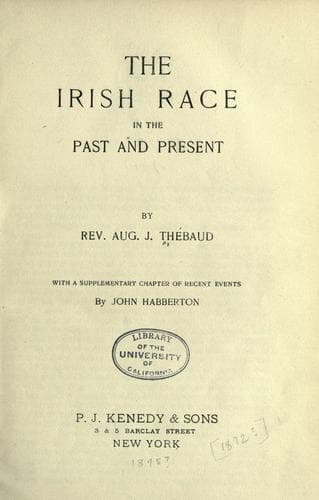
The Irish Race in the Past and the PresentThébaud, Augustus J.
History
The Irish Race in the Past and the Present
Thébaud, Augustus J.
Ireland -- History
And the only reward for their fidelity to King Charles I. could
under the circumstances be destruction. They waited with
resignation for the impending gloom to overshadow them. Terrible
moment for a nation, when despair itself fails to nerve it for
further resistance and possible success! Such was the position
of the Irish at the death of Charles.
Who shall describe that loyalty? After Ormond had met with the
defeat he deserved in the field; after the cities had fallen one
after another into the hands of the destroyer, who seldom
thought himself bound to observe the conditions of surrender;
after the chiefs, who might have protracted the struggle, had
disappeared either by death or exile, the doom of the nation was
sealed; yet it shrank not from the consequences.
The barbarities of Cromwell and his soldiers had depopulated
large tracts of territory to such an extent that the troops
marching through them were compelled to carry provisions as
through a desert. The cattle, the only resource of an
agricultural country, had been all consumed in a ten years' war.
It was reported that, after every successful engagement, the
republican general ordered all the men from the age of sixteen
to sixty to be slaughtered without mercy, all the boys from six
to sixteen to be deprived of sight, and the women to have a red-
hot iron thrust through their breasts. Rumors such as these,
exaggerated though they may be, testify at least to the terror
which Cromwell inspired. As for the captured cities, there can
be no doubt of the wholesale massacres carried out therein by
his orders. Of the entire population of Tredagh only thirty
persons survived, and they were condemned to the labor of slaves.
Hugh Peters, the chaplain of Fairfax, wrote after this
barbarous execution: "We are masters of Tredagh; no enemy was
spared; I just come from the church where I had gone to thank
the Lord."
The same fate awaited Wexford, and, later on, Drogheda. Cromwell,
when narrating those bloody massacres, concluded by saying,
"People blame me, but it was the will of God."
The Bible, the holy word of God, misread and misunderstood by
those fanatics, persuaded them that it would be a crime not to
exterminate the Irish, as the Lord punished Saul for having
spared Agag and the chief of the Amalekites. Whoever wishes for
further details of these sickening atrocities, committed in the
name of God, may find them in a multitude of histories of the
time, but chiefly in the "Threnodia" of Friar Morrison.
Certain modern Irish historians would seem not to understand the
heroism of their own countrymen. "Bitterly," says A. M.
O'Sullivan, "did the Irish people pay for their loyalty to an
English sovereign. Unhappily for their worldly fortunes, if not
for their fame, they were high-spirited and unfearing, where
pusillanimity would certainly have been safety, and might have
been only prudence."
Public-domain text, read in full here on John Shaqi.
Reviews
Reviews
No reviews yet
Be the first to share your thoughts on this work.
Elsewhere in the archive
Join the Discussion
Join the discussion
Sign in to leave a comment or review.
Sign InorCreate an account