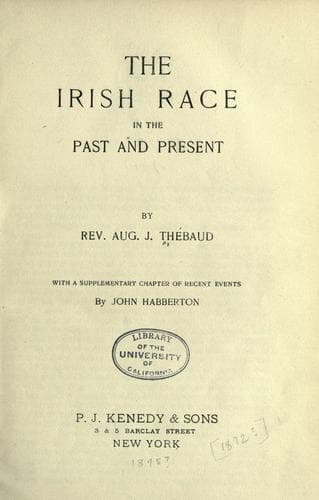
The Irish Race in the Past and the PresentThébaud, Augustus J.
History
The Irish Race in the Past and the Present
Thébaud, Augustus J.
Ireland -- History
Ever since the restoration of Charles II., many Englishmen have
professed great reverence for the memory of the "martyr-king."
Even the subsequent Revolution of 1658 left the monument erected
to him untouched. Many British families continued steady in
their devotion to the Scotch line, and the name of Jacobite was
for them a title of honor. Yet what were their sufferings for
the cause of the king during his struggle with the Parliament,
and after his execution? A few noblemen lost their lives and
estates; some went into exile and followed the fortunes of the
Pretenders who tried to gain possession of the throne. But the
bulk of the nation--England--may be said to have suffered
nothing by the great revolution which led to the Commonwealth.
On the contrary, it is acknowledged that the administration of
Cromwell at least brought peace to the country, and raised the
power of Great Britain to a higher eminence in Europe than it
had ever known before. As usual, the English made great
profession of loyalty, but, as a rule, were particularly careful
that no great inconvenience should come to them from it.
Treated with contempt and distrust by Charles and his advisers,
so insulted in every thing that was dear to her that it is still
a question for historians if, in many instances, the king and
the royalists did not betray her, Ireland alone, after having
taken her stand for a whole decade of years for God and the king,
resolved to face destruction unflinchingly in support of what
she imagined to be a noble cause.
After the landing of Cromwell, when to any sensible man there no
longer remained hope of serving the cause of the king, when the
desire which is natural to every human heart, of saving what can
be saved, might, not only without dishonor, but with justice and
right, have dictated the necessity of coming to terms with the
parliamentarians, and of abandoning a cause which was hopeless,
"on the 4th of December, 1649, Eber McMahon, Bishop of Clogher,
a mere Irishman by name, by descent, by enthusiastic attachment
to his country, exerted his great abilities to rouse his
countrymen to a persevering resistance to Cromwell, and to unite
all hearts and hands in the support of Ormond's administration. .
. . All the bishops concurred in his views, and subscribed a
solemn declaration that they would, to the utmost of their power,
forward his Majesty's rights, and the good of the nation. . . .
Ormond, at last, either sensible that no reliance could be
placed on them, or that the treachery of Inchiquin's troops was,
at least, on the part of the Irish, a fair ground of distrust
and suspicion of the remainder, consented to their removal."--
("Irish Catholics.")
"At last!" will be the reader's exclamation, while he wonders if
another people could be found forbearing enough to wait eight
years for the adoption of such a necessary measure.
Public-domain text, read in full here on John Shaqi.
Reviews
Reviews
No reviews yet
Be the first to share your thoughts on this work.
Elsewhere in the archive
Join the Discussion
Join the discussion
Sign in to leave a comment or review.
Sign InorCreate an account