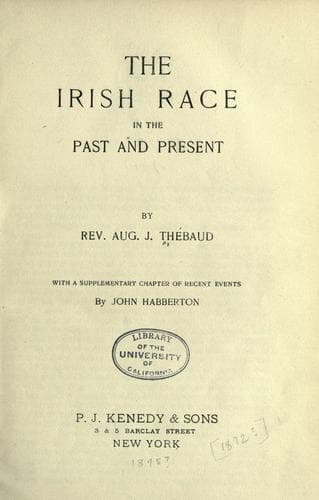
The Irish Race in the Past and the PresentThébaud, Augustus J.
History
The Irish Race in the Past and the Present
Thébaud, Augustus J.
Ireland -- History
And we may here remark that the number of a people and the
size of its territory have absolutely no bearing on the estimate
which we ought to form of its character. Who would say that
the Chinese are the most interesting and commendable nation
on the surface of the globe? They are certainly the most ancient
and most populous; their code of precise and formal morality is
the most exact and clear that philosophers could ever dictate,
and succeed in giving as law to a great people. That code
has been followed during a long series of ages. Most discoveries
of modern European science were known to them long before
they were found out among us; agriculture, that first of arts,
which most economists consider as the great test whereby to
judge of the worth of a nation, is and always has been carried by
them to a perfection unknown to us. Yet, the smallest European
nationality is, in truth, more interesting and instructive than
the vast Celestial Empire can ever be--whose long annals
are all compassed within a few hundred pages of a frigid
narrative, void of life, and altogether void of soul.
But why do we select, among so many others, the Irish nation,
which is so little known, of such little influence, whose history
occupies only a few lines in the general annals of the world,
and whose very ownership has rested in the hands of foreigners
for centuries?
We select it, first, because it is and always has been thoroughly
Catholic, from the day when it first embraced Christianity;
and this, under the circumstances, we take to be the best proof,
not only of supreme good sense, but, moreover, of an elevated,
even a sublime character. In their martyrdom of three centuries,
the Irish have displayed the greatness of soul of a Polycarp,
and the simplicity of an Agnes. And the Catholicity which
they have always professed has been, from the beginning, of a
thorough and uncompromising character. All modern European
nations, it is true, have had their birth in the bosom of the
Church. She had nursed them all, educated them all, made
them all what they were, when they began to think of emancipating
themselves from her; and the Catholic, that is, the Christian
religion, in its essence, is supernatural; the creed of the
apostles, the sacramental system; the very history of Christianity,
transport man directly into a region far beyond the earth.
Public-domain text, read in full here on John Shaqi.
Reviews
Reviews
No reviews yet
Be the first to share your thoughts on this work.
Join the Discussion
Join the discussion
Sign in to leave a comment or review.
Sign InorCreate an account