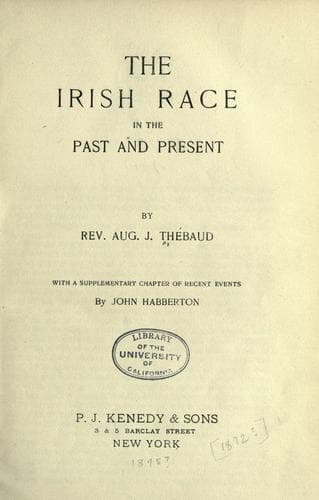
The Irish Race in the Past and the PresentThébaud, Augustus J.
History
The Irish Race in the Past and the Present
Thébaud, Augustus J.
Ireland -- History
England, the great leader in the material part of the social
movement which has been the subject of this chapter, for a long
time hesitated to adopt principles altogether subversive to
society. In her worldly good sense she endeavored to follow what
she imagined a _via media_ in her wisdom, to avoid what seemed
to her extremes, but what is in reality the eternal antagonism
of truth and falsehood, of order and chaos. Twenty years back
there was a unanimity among English writers to speak the
language of moderation and good sense whenever a rash author of
foreign nations hazarded some dangerous novelties; and in their
reviews they immediately pointed out the poison which lay
concealed under the covering of science or imagination, and the
peril of these ever-increasing new discoveries. If any
Englishman sanctioned those theories, he could not form a school
among his countrymen, and remained almost alone of his party.
But at last England has given way to the universal spread of
temptation, and to-day she runs the race of disorganization as
ardent as any, striving to be a leader among other leaders to
ruin. Every one is astounded at the sudden and remarkable change.
It is truly inexplicable, save by the fearful axiom, _Quos Deus
vult perdere, dementat_. Hence not a few expect soon to see
storms sweep over the devoted island of Great Britain, which no
longer forms an exception to the universality of the evil we
have indicated.
Which, then, is the one safe spot in Europe, whither the tide
of folly, or madness rather, has not yet come?
Ireland alone is the answer.
CHAPTER III.
THE IRISH BETTER PREPARED TO RECEIVE CHRISTIANITY THAN
OTHER NATIONS.
The introduction of Christianity gave Europe a power over the
world which pagan Rome could not possess. All the branches of
the Japhetic family combined to form what was with justice and
propriety called Christendom. Ireland, by receiving the Gospel,
was really making her first entry into the European family; but
there were certain peculiarities in her performance of this
great act which gave her national life, already deviating from
that of other European nations, a unique impulse. The first of
those peculiarities consisted in her preparation for the great
reception of the faith, and the few obstacles she encountered in
her adoption of it, compared with those of the rest of the world.
Public-domain text, read in full here on John Shaqi.
Reviews
Reviews
No reviews yet
Be the first to share your thoughts on this work.
Elsewhere in the archive
Join the Discussion
Join the discussion
Sign in to leave a comment or review.
Sign InorCreate an account