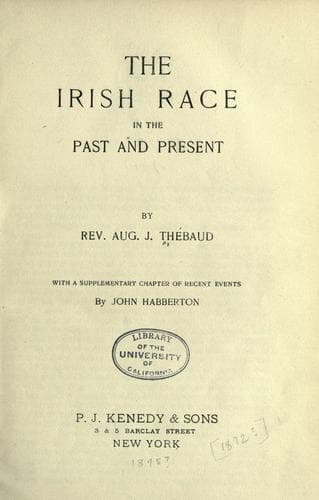
The Irish Race in the Past and the PresentThébaud, Augustus J.
History
The Irish Race in the Past and the Present
Thébaud, Augustus J.
Ireland -- History
Providence wisely decreed that redemption should be delayed
until a large portion of mankind had attained to the highest
civilization. It was not in a time of ignorance and barbarism
that the Saviour was born. The Augustan is, undoubtedly, the
most intellectual and refined age, in point of literary and
artistic taste, that the world has ever seen. A few centuries
before, Greece had reached the summit of science and art. No
country, in ancient or modern times, has surpassed the acumen of
her philosophical writers and the aesthetic perfection of her
poets and artists. Rome made use of her to embellish her cities,
and inherited her taste for science and literature.
But art and literature embody ideas only; and, as Ozanam says so
well: "Beneath the current of ideas which dispute the empire of
the world, lies that world itself such as labor has made it,
with that treasure of wealth and visible adornment which render
it worthy of being the transient sojourn-place of immortal souls.
Beneath the true, the good, and the beautiful, lies the useful,
which is brightened by their reflection. No people has more
keenly appreciated the idea of utility than that of Rome; none
has ever laid upon the earth a hand more full of power, or more
capable of transforming it; nor more profusely flung the
treasures of earth at the feet of humanity . . . .
"At the close of the second century . . the rhetorician
Aristides celebrated in the following terms the greatness of the
Roman Empire: 'Romans, the whole world beneath your dominion
seems to keep a day of festival. From time to time a sound of
battle comes to you from the ends of the earth, where you are
repelling the Goth, the Moor, or the Arab. But soon that sound
is dispersed like a dream. Other are the rivalries and different
the conflicts which you excite through the universe. They are
combats of glory, rivalries in magnificence between provinces
and cities. Through you, gymnasia, aqueducts, porticoes, temples,
and schools, are multiplied; the very soil revives, and the
earth is but one vast garden!'
"Similar, also, was the language of the stern Tertullian: `In
truth, the world becomes day after day richer and better
cultivated; even the islands are no longer solitudes; the rocks
have no more terrors for the navigator; everywhere there are
habitations, population, law, and life.'
"The legions of Rome had constructed the roads which furrowed
mountains, leaped over marshes, and crossed so many different
provinces with a like solidity, regularity, and uniformity; and
the various races of men were lost in admiration at the sight of
the mighty works which were attributed in after-times to Caesar,
to Brunehaud, to Abelard!"
Public-domain text, read in full here on John Shaqi.
Reviews
Reviews
No reviews yet
Be the first to share your thoughts on this work.
Elsewhere in the archive
Join the Discussion
Join the discussion
Sign in to leave a comment or review.
Sign InorCreate an account