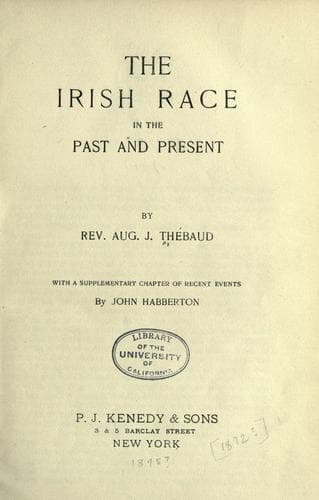
The Irish Race in the Past and the PresentThébaud, Augustus J.
History
The Irish Race in the Past and the Present
Thébaud, Augustus J.
Ireland -- History
In Plato, as read in Alexandria, Arius found all the material
for his doctrine, which spread like wild-fire over the whole
Church. Many things conspired to swell the number of his
adherents: the ardent love for philosophy so inherent in the
Eastern Church, to the extent of many believing that Plato was
almost a Christian, and his doctrines therefore endowed with
real authority; the natural disposition of men to adopt the new
and a seeming rational explanation of unfathomable mysteries;
the apparent agreement of his doctrine with certain passages of
Scripture, where the Son is said to be inferior to the Father;
but chiefly the satisfaction it afforded to a number of new
Christians who had embraced the faith at the conversion of
Constantine on political rather than conscientious grounds, and
who were at once relieved of the supernatural burden of
believing in a God-man, born of a woman, and dying on a cross.
Faith reduced to an opinion; religion become a philosophy; a
mere man, let his endowments be what they might, recognized as
our guide, and not overwhelming us with the dread weight of a
divine nature; all this explains the historic phrase of St.
Jerome after the Council of Rimini, "The world groaned and
wondered to find itself Arian."
Any person acquainted with ecclesiastical history knows how the
Church of Christ would have surely become converted into a mere
rational school, under the pressure of these doctrines, were it
not for the promises of perpetuity which she had received.
We know also what a time it took to establish truth: how many
councils had to meet, how many books had to be written, the
efforts required from the rulers of the Church, chiefly from the
Roman pontiffs, to calm so many storms, to explain so many
difficult points of doctrine, to secure the final victory.
And, after all had been accomplished, there still remained the
root of the evil engrafted in what we call the philosophical
turn of mind of the Western nations--that is to say, in the
disposition to call every thing in question, to seek out strange
and novel difficulties, to start war-provoking theories in the
midst of peace, to aim at founding a new school, or at least to
stand forth as the brilliant and startling expounder of old
doctrines in a new form, in fine to add a last name to the list,
already over-long, of those who have disturbed the world by
their skill in dialectics and sophism.
Pelagius followed Arius, and his errors had the same object in
view in the long-run, to strip our holy religion of all that is
spiritual and divine.
In the time of St. Augustine and St. Jerome, there existed among
Christians an extraordinary tendency to embrace all possible
philosophical doctrines, even when directly opposed to the first
principles of revealed religion; and, within the Church, the
danger of subtilizing on every question connected with well-
known dogmas was much greater than many imagine.
Public-domain text, read in full here on John Shaqi.
Reviews
Reviews
No reviews yet
Be the first to share your thoughts on this work.
Elsewhere in the archive
Join the Discussion
Join the discussion
Sign in to leave a comment or review.
Sign InorCreate an account