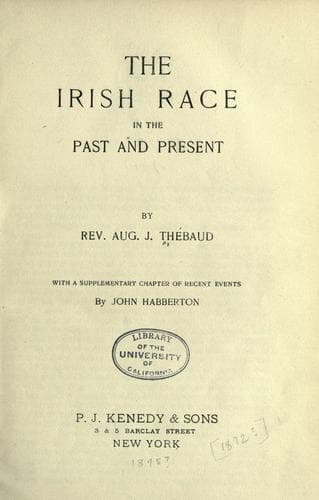
The Irish Race in the Past and the PresentThébaud, Augustus J.
History
The Irish Race in the Past and the Present
Thébaud, Augustus J.
Ireland -- History
But, though this might satisfy Julian and those who followed him
in his apostasy, it could not come to be an inner danger to the
Church. With many, however, it assumed a form which at once
engendered the worst errors of Gnosticism; and Gnosticism was,
at first, considered a Christian heresy; so that a man might be
a pantheist, of the worst kind, and still call himself Christian.
St. John had foreseen the danger from the beginning, and it is
said that he wrote his gospel against it because the doctrine
openly denied the divinity of Christ. But the sect became much
more powerful after his death, and allured many Christians who
were disposed, from a misinterpretation of some texts of St.
Paul on the struggle between the flesh and the spirit, to
embrace a system which professed to explain the origin of that
struggle.
The Alexandrian Gnosticism failed to excite in the minds of the
holy monks of the East that aversion which we now feel for its
tenets, inasmuch as it did not openly anathematize the
Scriptures of the Old Law, nay, even preserved a certain outward
respect for them, on account of the multitude of Jews living in
Alexandria, and particularly because the open system of Dualism,
which afterward came from Syria and in the hands of Manes
established the existence of two equal and eternal principles of
good and evil, found no place in the teachings of Valentinus and
his school.
But even this frightful Syrian Gnosticism, which gave to the
principle of evil an origin as ancient and sacred as that of God
himself--Manicheism barefaced and radically immoral--so
repugnant to our feelings, so monstrous to our more correct
ideas, bore a semblance of truth for many minds, at that time
inclined toward every thing which came from the East. We know
what a firm hold those doctrines took on the great soul of
Augustine, who for a long time professed and cherished them.
Rome, under the pagan emperors, had received with open arms the
Oriental gods and the philosophy which endeavored to explain
their mythology; and many gifted minds of the third and fourth
centuries lost themselves in the contemplation of those
mysteries which from out Central Asia spread a lurid glare over
the Western world.
This first danger, however, was warded off by the writings of St.
Ignatius of Antioch, St. Irenaeus of Lyons, Clement of
Alexandria, Tertullian, Origen, St. Epiphanius, Theodoret, and
others, long before the time of St. Augustine, the last of them.
Gnosticism was prevented from any longer imparting a wrong
tendency to Christian doctrines, and it died out, until restored
during the Crusades to revive in the middle ages in its most
malignant form.
But at the very moment of its decline, philosophy entered the
Church; almost to wreck her by inspiring Arius and Pelagius. The
teachings of the first were clearly Neo-Platonic; of the second,
Stoic: and all the errors prevalent in the Church from the third
to the sixth century originated in Arianism and Pelagianism.
Public-domain text, read in full here on John Shaqi.
Reviews
Reviews
No reviews yet
Be the first to share your thoughts on this work.
Elsewhere in the archive
Join the Discussion
Join the discussion
Sign in to leave a comment or review.
Sign InorCreate an account