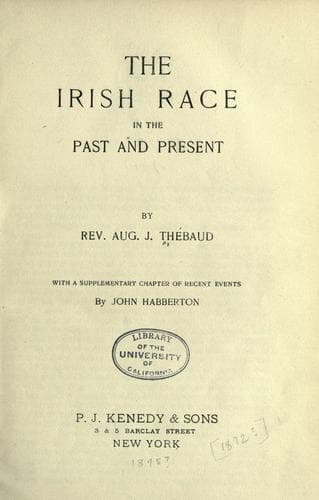
The Irish Race in the Past and the PresentThébaud, Augustus J.
History
The Irish Race in the Past and the Present
Thébaud, Augustus J.
Ireland -- History
Of old, throughout all countries, religion possessed certain
things in common, which belonged to the rites and creeds of all
nations, and were evidently derived from the primitive
traditions of mankind, and, consequently, from a true and Divine
revelation. Such were the belief in a golden age, in the fall
from a happy beginning, in the penalty imposed on sin, which
gave a reason for great mundane calamities--the Deluge chiefly--
the memory of which lived in the traditions of almost every
nation; in the necessity of prayer and expiatory sacrifice; in
the transmission of guilt from father to son, expressed in all
primitive legislations, and to this day preserved in the Chinese
laws and customs; in the existence of good and bad spirits,
whence, most probably, arose polytheism; in the hope of the
future regeneration of man, represented in Greece by the
beautiful myth of Pandora's box; and, finally, in the doctrine
of eternal rewards and punishments.
Each one of these strictly true dogmas underwent more or less of
alteration in its passage through the various nations of
antiquity, but was, nevertheless, everywhere preserved in some
shape or form.
At what precise epoch did mankind begin wrongfully to interpret
these primitive traditions? When did the worship of idols arise
and become universal? No one can tell precisely. All we know for
certain is, that a thousand years before Christ idolatry
prevailed everywhere, and that even the Jewish people often fell
into this sin, and were only brought back by means of punishment
to the worship of the true God.
But if error tainted the whole system of worship among nations,
it differed in the various races of men according to the variety
of their character. Ferocity or mildness of manners, acuteness
or obtuseness of understanding, activity or indolence of
disposition, a burning, a cold, or a temperate climate, a
smiling or dreary country, but chiefly the thousand differences
of temper which are as marked among mankind as the almost in-
finite variety of forms visible in creation, gave to each
individual religion its proper and characteristic types, which
in after-times, when truth was brought down from heaven for all,
imparted to the universal Christian spirit a peculiar outward
form in each people, an interior adaptation to its peculiar
dispositions, destined in the Divine plan to introduce into the
future Catholic Church the beautiful variety requisite to make
its very universality possible among mankind.
Public-domain text, read in full here on John Shaqi.
Reviews
Reviews
No reviews yet
Be the first to share your thoughts on this work.
Elsewhere in the archive
Join the Discussion
Join the discussion
Sign in to leave a comment or review.
Sign InorCreate an account