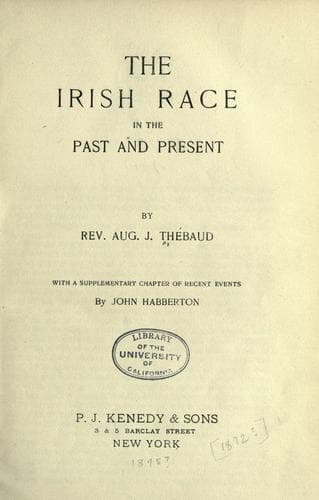
The Irish Race in the Past and the PresentThébaud, Augustus J.
History
The Irish Race in the Past and the Present
Thébaud, Augustus J.
Ireland -- History
To enter into details on the Celtic religion would carry us
beyond due limits. The question as to whether the ancient Celts
were idolaters or not still remains undecided, though in France
alone more than six hundred volumes have been written on the
subject. Julius Caesar believed that they were worshippers of
idols in the same sense as his own countrymen; but he probably
stood alone in his opinion. Aristotle, Pythagoras, Polyhistor,
Ammianus Marcellinus, considered the Druids as monotheist
philosophers. Most of the Greek writers agreed with them, as did
all the Alexandrian Fathers of the Church in the third and
fourth centuries.
Among the moderns the majority leans to a contrary opinion;
nevertheless, many authors of weight, distinguishing the public
worship of the common people from the doctrine of the Druids,
assert the monotheism of this sacerdotal caste. Samuel F. N.
Morus particularly, who, with J. A. Ernesti, was esteemed the
master of antiquarian scholarship in Europe during the last
century, maintains, in his edition of the "Commentaries" of
Caesar, that "human beings, as well as human affairs, fortunes,
travels, and wars, were thought by the Celts to be governed and
ruled by one supreme God, and that the system of apotheosis,
common to nearly all ancient nations, was totally unknown in
ancient Gaul, Britain, and the adjacent islands."
The ancient authorities concurring with these conclusions are so
numerous and clear spoken that the great historian of Gaul,
Amedee Thierry, thinks that such a pure and mystic religion,
joined to such a sublime philosophy, could not have been the
product of the soil. In his endeavor to investigate its origin,
he supposes that it was brought to the west of Europe by the
Eastern Cymris of the first invasion; that it was adopted by the
higher classes of society, and that the old idolatrous worship
remained in force among the lower orders.
The unity and omnipotence of the Godhead, metempsychosis, or the
doctrine and the transmigration of soul --not into the bodies of
animals, as it obtained and still obtains in the East, but into
those of other human beings--the eternal duration of existing
substances, material and spiritual, consequently the immortality
of the human soul, were the chief dogmas of the Druids,
according to the majority of antiquarians.
If this be true, then it can be said boldly that, with the
exception of revealed religion in Judea, which was always far
more explicit and pure, no system can be found in ancient times
superior to that of the Druids, more especially if we add that,
in addition to religious teaching, a whole system of physics was
also developed in their large academies. "They dispute," says
Caesar, "on the stars and their motions, on the size of the
universe and of this earth, on the nature of physical things, as
well as on the strength and power of the eternal God."
Public-domain text, read in full here on John Shaqi.
Reviews
Reviews
No reviews yet
Be the first to share your thoughts on this work.
Elsewhere in the archive
Join the Discussion
Join the discussion
Sign in to leave a comment or review.
Sign InorCreate an account