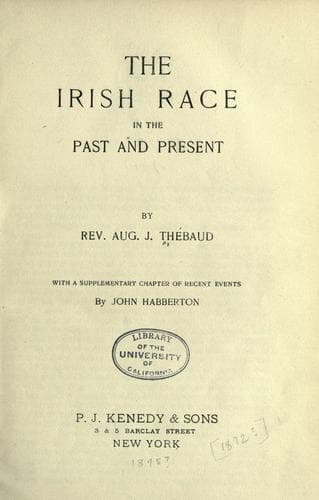
The Irish Race in the Past and the PresentThébaud, Augustus J.
History
The Irish Race in the Past and the Present
Thébaud, Augustus J.
Ireland -- History
There was a time when all the large cromlechs which abound in
the island were believed to be sacrificial stones; and it is
highly probable that the opinion so prevalent during the last
century with respect to the reality of those cruel rites had its
origin in the existence of those rude monuments. After many
investigations and excavations around and under cromlechs of all
sizes, it is now admitted by all well-informed antiquarians that
they had no connection with sacrifices of any kind. They were
merely monuments raised over the buried bodies of chieftains or
heroes. Many sepulchres of that description have been opened,
either under cromlechs or under large mounds; great quantities
of ornaments of gold, silver, or precious stones, utensils of
various materials, beautiful works of great artistic merit, have
been discovered there, and now go to fill the museums of the
nation or private cabinets. Nothing connected with religious
rites of any description has met the eyes of the learned seekers
after truth. Thus it has been ascertained that the old race had
reached a high degree of material civilization; but no clew to
its religion has been furnished.
As to fire-worship, which not long ago was admitted by all as
certainly forming a part of the Celtic religion in Ireland, so
little of that opinion remains to-day that it is scarcely
deserving of mention. There now remains no doubt that the round
towers, formerly so numerous in Ireland, had nothing whatever to
do with fire-worship. For a long time they were believed to have
been constructed for no other object, and consequently long
prior to the coming of St. Patrick. But Dr. Petrie and other
antiquarians have all but demonstrated that the round towers
never had any connection with superstition or idolatry at all;
that they were of Christian origin, always built near some
Christian church, and of the same materials, and had for their
object to call the faithful to prayer, like the _campanile_ of
Italy, to be a place of refuge for the clergy in time of war,
and to give to distant villages intimation of any hostile
invasion.
The fact in the life of St. Patrick, when he appeared before the
court of King Laeghaire, upon which so much reliance is placed
as a proof of the existence of fire-worship, is now of
proportionate weakness. It seems, to judge by the most reliable
and ancient manuscripts, that, after all, the kindling of the
king's fire was scarcely a religious act.
McGeoghegan, whose history is compiled, from the best-
authenticated documents, says: "When the monarch convened an
assembly, or held a festival at Tara, it was customary to make a
bonfire on the preceding day, and it was forbidden to light
another fire in any other place at the same time, in the
territory of Breagh."
Public-domain text, read in full here on John Shaqi.
Reviews
Reviews
No reviews yet
Be the first to share your thoughts on this work.
Elsewhere in the archive
Join the Discussion
Join the discussion
Sign in to leave a comment or review.
Sign InorCreate an account