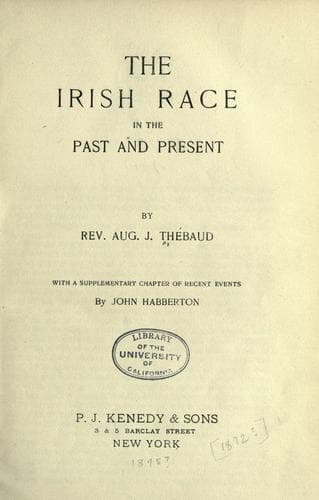
The Irish Race in the Past and the PresentThébaud, Augustus J.
History
The Irish Race in the Past and the Present
Thébaud, Augustus J.
Ireland -- History
This is all; and the probable cause of the prohibition was to do
honor to the king. Had it been an act of worship, Patrick, in
lighting his own paschal-fire, would not only have shown
disrespect to the monarch, but in the eyes of the people
committed a sacrilege, which could scarcely have missed mention
by the careful historians of the time.
But the proof that we are right in our interpretation of the
ceremony is clear, from the following passage, taken from the
work of Prof. Curry on "Early Irish Manuscripts:" "We see, by
the book of military expeditions, that, when King Dathi-- the
immediate predecessor of Laeghaire on the throne of Ire- land--
thought of conquering Britain and Gaul, he invited the states of
the nation to meet him at Tara, at the approaching feast of
Baltaine (one of the great pagan festivals of ancient Erin) on
May-day.
"The feast of Tara this year was solemnized on a scale of
splendor never before equalled. The fires of Lailten (now called
Lelltown in the north of Ireland) were lighted, and the sports,
games, and ceremonies, were conducted with unusual magnificence
and solemnity.
"These games and solemnities are said to have been instituted
more than a thousand years previously by Lug, in honor of Lailte,
the daughter of the King of Spain, and wife of MacEire, the
last king of the Firbolg colony. It was at her court that Lug
had been fostered, and at her death he had her buried at this
place, where he raised an immense mound over her grave, and
instituted those annual games in her honor.
"These games were solemnized about the first day of August, and
they continued to be observed down to the ninth century"-
therefore, in Christian times-and consequently the lighting of
the fires had as little connection with fire-worship as the
games with pagan rites.
A more serious difficulty meets us in the destruction of Crom
Cruagh by St. Patrick, and it is important to consider how far
Crom Cruagh could really be called an idol.
With regard to the statues of Celtic gods, all the researches
and excavations which the most painstaking of antiquarians have
undertaken, especially of late years, have never resulted in the
discovery, not of the statue of a god, but of any pagan sign
whatever in Ireland. It is clear, from the numerous details of
the life of St. Patrick, that he never encountered either
temples or the statues of gods in any place, although occasional
mention is made of idols. The only fact which startles the
reader is the holy zeal which moved him to strike with his
"baculus Jesu" the monstrous Crom Cruagh, with its twelve "sub-gods."
Public-domain text, read in full here on John Shaqi.
Reviews
Reviews
No reviews yet
Be the first to share your thoughts on this work.
Elsewhere in the archive
Join the Discussion
Join the discussion
Sign in to leave a comment or review.
Sign InorCreate an account