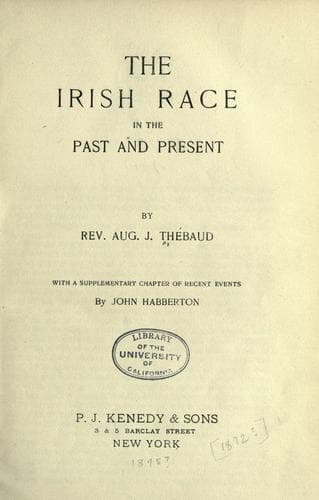
The Irish Race in the Past and the PresentThébaud, Augustus J.
History
The Irish Race in the Past and the Present
Thébaud, Augustus J.
Ireland -- History
Whatever explanation of the whole occurrence may be given, we
doubt if we shall find a better than that we advance, and the
considerations arising from it justify the opinion that the
Irish Celts were not idolaters like all other peoples of
antiquity. They possessed no mythology beyond harmless fairy-
tales, no poetical histories of gods and goddesses to please the
imagination and the senses, and invest paganism with such an
attractive garb as to cause it to become a real obstacle to the
spread of Christianity.
Moreover, what we have said concerning the belief in the
omnipotence of one supreme God, whatever might be his nature, as
the first dogma of Druidism, would seem to have lain deep in the
minds of the Irish Celts, and caused their immediate
comprehension and reception of monotheism, as preached by St.
Patrick, and the facility with which they accepted it. They were
certainly, even when pagans, a very religious people; otherwise
how could they have embraced the doctrines of Christianity with
that ardent eagerness which shall come under our consideration
in the next chapter? A nation utterly devoid of faith of any
kind is not apt to be moved, as were the Irish, perhaps beyond
all other nations, at the first sight of supernatural truths,
such as those of Christianity. And so little were they attached
to paganism, so visibly imbued with reverence for the supreme
God of the universe, that, as soon as announced, they accepted
the dogma.
The simple and touching story of the conversion of the two
daughters of King Laeghaire will give point and life to this
very important consideration. It is taken from the "Book of
Armagh," which Prof. O'Curry, who is certainly a competent
authority, believes older than the year 727, when the popular
Irish traditions regarding St. Patrick must have still been
almost as vivid as immediately after his death.
St. Patrick and his attendants being assembled at sunrise at the
fountain of Clebach, near Cruachan in Connaught, Ethne and
Felimia, daughters of King Laeghaire, came to bathe, and found
at the well the holy men.
"And they knew not whence they were, or in what form, or from
what people, or from what country; but they supposed them to be
fairies--_duine sidhe_--that is to say, gods of the earth, or a
phantasm.
"And the virgins said unto them: 'Who are ye, and whence are ye?'
"And Patrick said unto them: 'It were better for you to confess
to our true God, than to inquire concerning our race.'
"The first virgin said: `Who is God?
"'And where is God?
"'And where is his dwelling-place?
"'Has God sons and daughters, gold and silver?
"'Is he living?
"'Is he beautiful?
"'Did many foster his son?
"'Are his daughters dear and beauteous to men of this world?
"'Is he in heaven or on earth?
"'In the sea?--In rivers?--In mountainous places?--In valleys?
"'Declare unto us the knowledge of him?
"'How shall he be seen?-How shall he be loved?-How is he to be found?
Public-domain text, read in full here on John Shaqi.
Reviews
Reviews
No reviews yet
Be the first to share your thoughts on this work.
Elsewhere in the archive
Join the Discussion
Join the discussion
Sign in to leave a comment or review.
Sign InorCreate an account