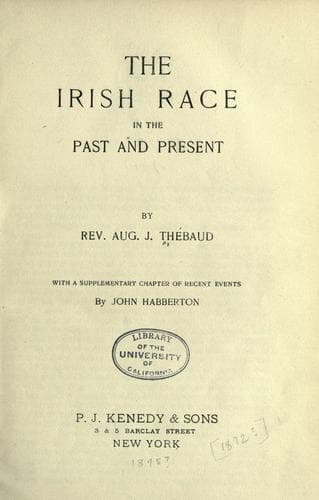
The Irish Race in the Past and the PresentThébaud, Augustus J.
History
The Irish Race in the Past and the Present
Thébaud, Augustus J.
Ireland -- History
In all his travels through Ireland-and there is scarcely a spot
which he did not visit and evangelize-St. Patrick meets with
only one idol, or rather group of idols, situated in the County
Cavan, which was an object of veneration to the people. Nowhere
else are idols to be found, or the saint would have thought it
his duty to destroy them also. This first fact certainly places
the Irish in a position, with regard to idolatry, far different
from that of all other polytheist nations. In all other
countries it is characteristic of polytheism to multiply the
statues of the gods, to expose them in all public places, in
their houses, but chiefly within or at the door of edifices
erected for the purpose. Yet in Ireland we find nothing of the
kind, with the exception of Crom Cruagh. The holy apostle of the
nation goes on preaching, baptizing, converting people, without
finding any worship of gods of stone or metal; he only hears
that there is something of the kind in a particular spot, and he
has to travel a great distance in order to see it, and show the
people their folly in venerating it.
But what was that idol? According to the majority of expounders
of Irish history, it was a golden sphere or ball representing
the sun, with twelve cones or pillars of brass, around it,
typifying, probably, astronomical signs. St. Patrick, in his
"Confessio," seems to allude to Crom Cruagh when he says: "That
sun which we behold by the favor of God rises for us every day;
but its splendor will not shine forever; nay, even all those who
adore it shall be miserably punished."
The Bollandists, in a note on this passage of the "Confessio,"
think that it might refer to Crom Cruagh, which possibly
represented the sun, surrounded by the signs of the twelve
months, through which it describes its orbit during the year.
We know that the Druids were, perhaps, better versed in the
science of astronomy than the scholars of any other nation at
the time. It was not in Gaul and Britain only that they pursued
their course of studies for a score of years; the same fact is
attested for Ireland by authorities whose testimony is beyond
question. May we not suppose that a representation of mere
heavenly phenomena, set in a conspicuous position, had in course
of time become the object of the superstitious veneration of the
people, and that St. Patrick thought it his duty to destroy it?
And the attitude of the people at the time of its destruction
shows that it could not have borne for them the same sacred
character as the statue of Minerva in the Parthenon did for the
Greeks or that of Capitoline Jove for the Romans. Can we suppose
that St. Paul or St. Peter would have dared to break either of
these? And let us remark that the event we discuss occurred at
the very beginning of St. Patrick's ministry, and before he had
yet acquired that great authority over the minds of all which
afterward enabled him fearlessly to accomplish whatever his zeal
prompted him to do.
Public-domain text, read in full here on John Shaqi.
Reviews
Reviews
No reviews yet
Be the first to share your thoughts on this work.
Elsewhere in the archive
Join the Discussion
Join the discussion
Sign in to leave a comment or review.
Sign InorCreate an account