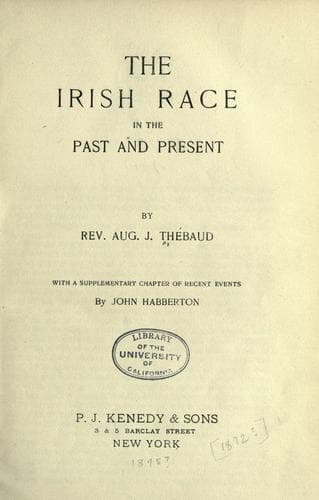
The Irish Race in the Past and the PresentThébaud, Augustus J.
History
The Irish Race in the Past and the Present
Thébaud, Augustus J.
Ireland -- History
He was a Druid, being the chief poet of King Laeghaire--all
poets belonging to the order. After the wife, the brothers, and
the two daughters of the monarch, he was the most illustrious
convert gained by Patrick at the beginning of his apostleship.
He became a Christian at the first appearance of the saint at
Tara, and immediately began to sing in verse his new belief, as
he had formerly sung the heroes of his nation. To the end he
remained firm in his faith, and a dear friend to the holy man
who had converted him. How could he, and all the chief converts
of Patrick, have believed so suddenly and so constantly in the
God of the Christians, if their former life had not prepared
them for the adoption of the new doctrine, and if the doctrine
of monotheism had offered a real difficulty to their
understanding? There was, probably, nothing clear and definite
in their belief in an omnipotent God, which is said to have been
the leading dogma of Druidism; but their simple minds had
evidently a leaning toward the doctrine, which induced them to
approve of it, as soon as it was presented to them with a solemn
affirmation.
In order to elucidate this point, we add a short description of
the labors and success of this apostle.
In the year 432, Patrick lands on the island. By that time, some
few of the inhabitants may possibly have heard of the Christian
religion from the neighboring Britain or Gaul. Palladius had
preached the year before in the district known as the present
counties of Wexford and Wicklow, erected three churches, and
made some converts; but it may be said that Ireland continued in
the same state it had preserved for thousands of years: the
Druids in possession of religious and scientific supremacy; the
chieftains in contention, as in the time of Fingal and Ossian;
the people, though in the midst of constant strife, happy enough
on their rich soil, cheered by their bards and poets; very few,
or no slaves in the country; an abundance of food everywhere;
gold, silver, precious stones adorning profusely the persons of
their chiefs, their wives, their warriors; rich stuffs, dyed
with many colors, to distinguish the various orders of society;
a deep religious feeling in their hearts, preparing them for the
faith, by inspiring them with lively emotions at the sight of
divine power displayed in their mountains, their valleys, their
lakes and rivers, and on the swelling bosom of the all-
encircling ocean; superstitions of various kinds, indeed, but
none of a demoralizing character, none involving marks of
cruelty or lust; no revolting statues of Priapus, of Bacchus, of
Cybele; no obscene emblems of religion, as in all other lands,
to confront Christianity; but over all the island, song,
festivity, deep affection for kindred; and, as though blood-
relationship could not satisfy their heart, fosterage covering
the land with other brothers and sisters; all permeated with a
strong attachment to their clan-system and social customs. Such
Public-domain text, read in full here on John Shaqi.
Reviews
Reviews
No reviews yet
Be the first to share your thoughts on this work.
Elsewhere in the archive
Join the Discussion
Join the discussion
Sign in to leave a comment or review.
Sign InorCreate an account