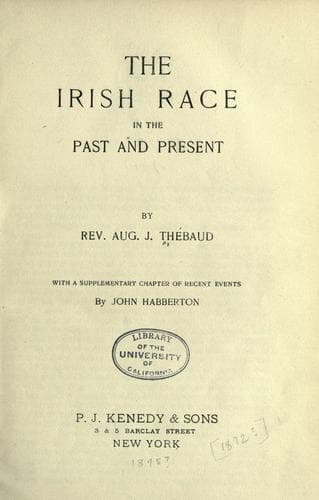
The Irish Race in the Past and the PresentThébaud, Augustus J.
History
The Irish Race in the Past and the Present
Thébaud, Augustus J.
Ireland -- History
is an exact picture of the Erin of the time, which the study of
antiquity brings clearer and clearer before the eyes of the
modern student.
Patrick appears among them, leaning on his staff, and bringing
them from Rome and Gaul new songs in a new language set to a new
melody. He comes to unveil for them what lies hidden, unknown to
themselves, in the depths of their hearts. He explains, by the
power of one Supreme God, why it is that their mountains are so
high, their valley so smiling, their rivers and lakes teeming
with life, their fountains so fresh and cool, and that sun of
theirs so temperate in its warmth, and the moon and stars,
lighted with a soft radiance, shimmering over the deep obscurity
of their groves.
He directs them to look into their own consciences, to admit
themselves to be sinners in need of redemption, and points out
to them in what manner that Supreme God, whom they half knew
already, condescended to save man.
Straightway, from all parts of the island, converts flock to him;
they come in crowds to be baptized, to embrace the new law by
which they may read their own hearts; they are ready to do
whatever he wishes; many, not content with the strict
commandments enjoined on all, wish to enter on the path of
perfection: the men become monks, the women and young girls nuns,
that is to say, spouses of Christ. In Munster alone "it would
be difficult," says a modern writer, Father Brenan, "to form an
estimate of the number of converts he made, and even of the
churches and religious establishments he founded."
And so with all the other provinces of the island. The proof's
still stand before our eyes. For, as Prof. Curry justly remarks:
"No one, who examines for himself, can doubt that at the first
preaching in Erin of the glad tidings of salvation, by Saints
Palladius and Patrick, those _countless_ Christian churches were
built, whose sites and ruins mark so thickly the surface of our
country even to this day, still bearing through all the
vicissitudes of time and conquest the _unchanged names of their
original founders_."
According to the commonly-received opinion, St. Patrick's
apostleship lasted thirty-three years; but, whatever may have
been its real duration, certain it is that his feet traversed
the whole island several times, and, at his passing, churches
and monasteries sprang up in great numbers, and remained to tell
the true story of his labors when their founder had passed away.
Public-domain text, read in full here on John Shaqi.
Reviews
Reviews
No reviews yet
Be the first to share your thoughts on this work.
Elsewhere in the archive
Join the Discussion
Join the discussion
Sign in to leave a comment or review.
Sign InorCreate an account