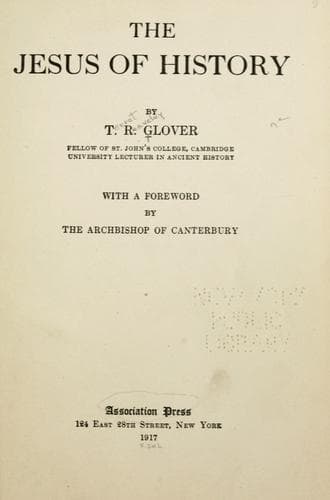
The Jesus of HistoryGlover, T. R. (Terrot Reaveley)
Religion
The Jesus of History
Glover, T. R. (Terrot Reaveley)
Jesus Christ -- Historicity
There is a growing agreement among scholars that there is some
confusion in our data as to John the Baptist. There are gaps in the
record--for instance, how and why did the school of John survive as
it did (Acts 18:25, 19:1-7)? And again there are, in the judgement
of some, developments of the story. The Gospel, with varying degrees
of explicitness, and St. Paul by inference (Acts 19:4) tell us that
John pointed to "him which should come after him." Christians, at
any rate, after the Resurrection, had no doubt that this was Jesus.
Whether John was as definite as the narratives now represent him to
have been, has been doubted in view of his message to Jesus. But
that is not our present subject. We are concerned less with John as
precursor than as teacher and thinker.
Even if our data are defective, still enough is given us to let us
see a very striking and commanding figure. We have a picture of him,
his dress, his diet, his style of speech, his method of action--in
every way he is a signal and arresting man. The son of a priest, he
is an ascetic, who lives in the wilderness, dresses like a peasant,
and eats the meanest and most meagre of food--a man of the desert
and of solitude. And the whole life reacts on him and we can see
him, lean and worn, though still a young man, a keen, rather
excitable spirit--in every feature the marks of revolt against a
civilization which he views as an apostasy. Luke, using a phrase
from the Old Testament, says, "The word of God came upon John in the
wilderness" (Luke 3:2). Luke leans to Old Testament phrase, and here
is one that hits off the man to the very life. Jesus himself
confirms Luke's judgement (Mark 11:29-33). The Word of the Lord has
come on this ascetic figure, and he goes to the people with the
message; he draws their attention and they crowd out to see him. He
makes a great sensation. He is not like other men--for Jesus quotes
their remark that "he had a devil" (Luke 7:33)--a rough and ready
way of explaining unlikeness to the average man. When he sees his
congregation his words are not conciliatory; he addresses them as a
"generation of vipers" (Luke 3:7); and his text is the "wrath to
come."
Public-domain text, read in full here on John Shaqi.
Reviews
Reviews
No reviews yet
Be the first to share your thoughts on this work.
Elsewhere in the archive
Join the Discussion
Join the discussion
Sign in to leave a comment or review.
Sign InorCreate an account