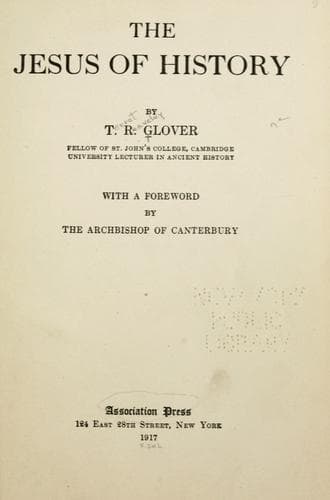
The Jesus of HistoryGlover, T. R. (Terrot Reaveley)
Religion
The Jesus of History
Glover, T. R. (Terrot Reaveley)
Jesus Christ -- Historicity
"John," writes the historian Josephus a generation later, "was a
good man, and commanded the Jews to exercise virtue both in justice
toward one another and piety towards God, and so to come to baptism;
for so baptism would be acceptable to God if they made use of it,
not to excuse certain sins, but for the purification of the body,
provided that the soul was thoroughly purified beforehand by
righteousness."[28] This interpretation of John's baptism makes it
look very like the baptisms and other purificatory rites of the
heathen. The Gospels attribute to John a message, richer and more
powerful, but essentially the same; and the criticism of Jesus
confirms the account. The great note in his preaching is judgement;
the Kingdom of God is coming, and it begins with judgement. Again,
it is like Amos--"The axe is at the root of the tree," "His fan is
in His hand." And as men listened to the man and looked at him--his
intense belief in his message, backed up by a stern self-discipline,
a whole life inspired, infused by conviction--they believed this
message of the axe, the fan, and the fire. They asked and as we have
seen received his guidance on the conduct of life; they accepted his
baptism, and set about the amending of character (Matt. 21:32).
Jesus makes it quite clear that he held John to be an entirely
exceptional man, and that he had no doubt that John's teaching was
from God (Matt. 21:32; Luke 7:35, 20:4; and, of course, Luke
7:26-28). It was all in the line of the great prophets; and the
Fourth Gospel shows it us once more in the work of the Holy
Spirit--"when he is come, he will reprove (convict) the world of
sin, and of righteousness, and of judgement" (John 16:8). And yet,
as Jesus says, there is all the difference in the world between his
own Gospel and the teaching of the Baptist.
In Mark's narrative (2:18) a very significant episode is recorded.
John inculcated fasting, and his disciples fasted a great deal
("pykna", Luke 5:33); and once, Mark tells us, when they were
actually fasting, they asked Jesus why his disciples did not do the
same? Jesus' answer is a little cryptic at first sight. "Can the
children of the bridechamber fast, while the bridegroom is with
them?" Who fasts at the wedding feast, in the hour of gladness? And
then he passes on to speak about the new patch on the old garment,
the new wine in the old wine skins; and it looks as if it were not
merely a criticism of John's disciples but of John himself. John,
indeed, brings home with terrific force and conviction that truth of
God which the prophets had preached before; but he leaves it there.
He emphasizes once more the old laws of God, the judgements of God,
but he brings no transforming power into men's lives. The old
characters, the old motives more or less, are to be patched by a new
fear.
Public-domain text, read in full here on John Shaqi.
Reviews
Reviews
No reviews yet
Be the first to share your thoughts on this work.
Elsewhere in the archive
Join the Discussion
Join the discussion
Sign in to leave a comment or review.
Sign InorCreate an account