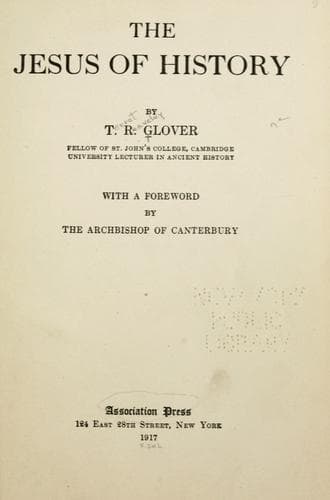
The Jesus of HistoryGlover, T. R. (Terrot Reaveley)
Religion
The Jesus of History
Glover, T. R. (Terrot Reaveley)
Jesus Christ -- Historicity
Imperial Rome governed the whole of the Mediterranean world,--a
larger proportion and a greater variety of the human race than has
ever been under one government. So far as numbers go, the Russian
Empire to-day, the Chinese and the British, each far exceed it; for
the population of the world is vastly larger than it was in Rome's
days. But there was a peculiar unity about the Roman Empire, for it
embraced, as men thought, all civilized mankind. It was known that,
far away in the East, there were people called Indians, who had
fought with Alexander the Great, but there was little real knowledge
of them. Beyond India, there were vague rumours of a land where silk
grew on the leaves of the trees. But civilized mankind was under the
control of Rome. It was one rule of many races, many kingdoms,
princedoms, cities, cantons, and tribes--a wise rule, a rule that
allowed the maximum of local government and traditional usage: Rome
not merely conquered but captured men all over the world; ruled
them, as a poet said, like a mother, not a queen, and bound them to
herself. Men were eager, not so much to shake off her yoke, as to be
Romans; and from the Atlantic to the Euphrates men, not of Roman
blood, were proud to bear Roman names and to be Roman citizens. "I
was free born," said St. Paul, not without a touch of satisfaction
(Acts 22:25-28). A general peace prevailed through the Roman
world--a peace that was new to mankind. There was freedom of
intercourse; one of the boasts made by the writers of the Roman
Empire is of this new freedom to travel, to go anywhere one pleased.
Piracy on the sea, brigandage on the land, had been put down, and
there was a very great deal of travel. The Roman became an
inveterate tourist. He went to the famous scenes of Asia Minor, to
Troy above all--to "sunny Rhodes and Mitylene"--to Egypt. Merchants
went everywhere. And there was a fusing of cultures, traditions, and
creeds, all over the Mediterranean world. Centuries before,
Alexander the Great had struck out the splendid idea of the marriage
of East and West. He secured it by breaking down the Persian Empire,
and making one Empire from the Adriatic to this side of the Sutlej
or Bias. He desired to cement this marriage of East and West in a
way of his own. He took three hundred captive princesses and ladies,
and married them in a batch to Macedonian officers--a very
characteristic piece of symbolism. But his idea was greater and
truer than the symbol.
Public-domain text, read in full here on John Shaqi.
Reviews
Reviews
No reviews yet
Be the first to share your thoughts on this work.
Elsewhere in the archive
Join the Discussion
Join the discussion
Sign in to leave a comment or review.
Sign InorCreate an account