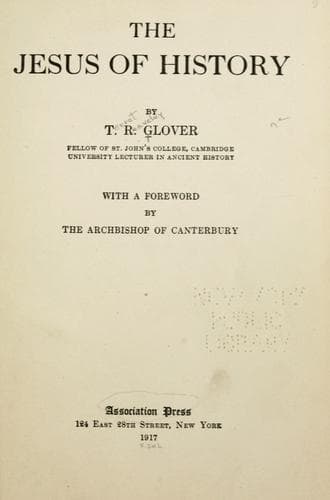
The Jesus of HistoryGlover, T. R. (Terrot Reaveley)
Religion
The Jesus of History
Glover, T. R. (Terrot Reaveley)
Jesus Christ -- Historicity
The Roman marriage of the East and West was a more real thing, for
behind it lay three centuries of growing intercourse and knowledge
along Alexander's lines. In the sphere of religion we find it most
clearly. There rises a resultant world-religion--a religion that
embraces all the cults, all the creeds, and at last all the
philosophies, in one great system. That religion held the world. It
is true, there were exceptions. There was a small and objectionable
race called Jews; there were possibly some Druids in Southern
Britain; and here and there was a solitary atheist who represented
no one but himself. These few exceptions were the freaks amongst
mankind. Apart from them mankind was united in its general beliefs
about the gods. The world had one religion.
First of all, let us try to estimate the strength of this old
Mediterranean Paganism. It was strong in its great traditions.
Plutarch, who lived from about 50 A.D. to 117 or so, is our great
exponent of this old religion. To him I shall have to refer
constantly. He was a writer of charm, a man with many gifts.
Plutarch's Lives was the great staple of education in the
Renaissance--and as good a one, perhaps, as we have yet discovered,
even in this age when there are so many theories of education with
foreign names. Plutarch, then, writing about Delphi, the shrine and
oracle of the god Apollo, said that men had been "in anguish and
fear lest Delphi should lose its glory of three thousand years"--and
Delphi has not lost it. For ninety generations the god has been
giving oracles to the Greek world, to private people, to kings, to
cities, to nations--and on all sorts of subjects, on the foundation
of colonies, the declaration of wars, personal guidance and the hope
of heirs. You may test the god where you will, Plutarch claimed, you
will not find an instance of a false oracle. Readers of Greek
history will remember another great writer of as much charm, five
hundred years before, Herodotus, who was not so sure about all the
oracles. But let us think what it means,--to look back over three
thousand years of one faith, unbroken. Egyptian religion had been
unchallenged for longer still, even if we allow Plutarch's three
thousand years. The oldest remains in Egypt antedate, we are told,
4000 B.C., and all through history, with the exception of the
solitary reign of Amen-Hotep III., Egypt worshipped the same gods,
with additions, as time went on. Again an unbroken tradition. And
how long, under various names, had Cybele, Mother of Gods, been
worshipped in Asia? By our era all these religions were fused into
one religion, of many cults and rites and ancient traditions; and
the incredible weight of old tradition in that world is hard to
overestimate.
Public-domain text, read in full here on John Shaqi.
Reviews
Reviews
No reviews yet
Be the first to share your thoughts on this work.
Elsewhere in the archive
Join the Discussion
Join the discussion
Sign in to leave a comment or review.
Sign InorCreate an account