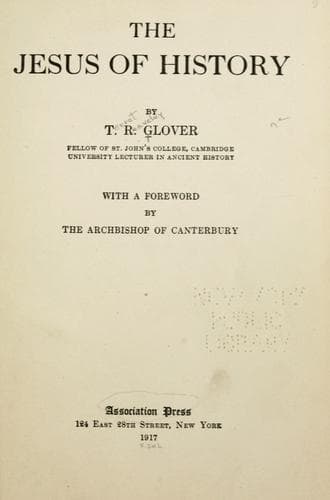
The Jesus of HistoryGlover, T. R. (Terrot Reaveley)
Religion
The Jesus of History
Glover, T. R. (Terrot Reaveley)
Jesus Christ -- Historicity
[19] Cf. A. E. J. Rawlinson, Dogma, Fact and Experience, p. 16. "All
the virtues in the Aristotelian canon are self-contained states of
the virtuous man himself .... In the last resort they are entirely
self-centred adornments or accomplishments of the good man; and it
is significant of this self-centredness of the entire conception
that the qualities of display (megaloprepeia) and highmindedness, or
proper pride (megalopsychia), are insisted on as integral elements
of the ideal character. On the other hand, the three characteristic
Christian virtues--faith, hope and charity--all postulate Another."
[20] Cf. Chapter II
[21] A French mystic is quoted as saying, "Le Dieu défini est le Dieu
fini."
[22] Peabody, Jesus Christ and Christian Character, p. 97.
[23] H. R. Mackintosh, "The Doctrine of the Person of Jesus Christ",
p. 399.
[24] Clement, "Protrepticus", 100, 3, 4
[25] The more or less contemporary Greek orator, Dio Chrysostom,
refers to the old-fashioned ways of the Tarsiots, especially
mentioning their insistence on women wearing veils.
[26] Wernle, "Beginnings of Christianity", vol. i. p. 286, English
translation.
[27] So too says Josephus, who gives this as the reason of Herod's
suspicion of him.
[28] "Antiquities of the Jews", xviii. 5, 8, 117, cf. what Celsus
says of righteousness as a condition of admission to certain
mysteries that offer forgiveness of sins (Origen, c. "Celsum", iii.
59). The "purification of the body" has a ritual and ceremonial
significance.
[29] Lines Composed above Tintern, 34.
[30] That he did so is emphasized again and again, in striking
language, by St. Paul--e.g. Rom. 5:15-16, 20; 1 Tim. 1:14.
[31] Horace, "Ars Poetica", 191, "Nec deus intersit nisi dignus
vindice nodus inciderit".
[32] Daily reading of the Scriptures is recommended by Clement of
Alexandria ("Strom". vii. 49).
[33] Perhaps one may quote here, not inappropriately, the famous
saying of Aristotle in his "Poetics", that "poetry is a more
philosophic thing than history, and of a higher seriousness." The
latter term means that the poet is "more in earnest" about his work,
and puts more energy of mind into it than the historian. If the
reader hesitates about this, let him try to write a great hymn or
poem.
[34] Do not let us be misled by the thin pedantries of the Revised
Version here, or in Romans 5:1 shortly to be cited. In both places
literary and spiritual sense has bowed to the accidents of MSS.
[35] If my readers do not know his Christmas hymn for children, they
have missed one of the happiest hymns for Christmas.
[36] What Carlyle says in "The Hero as a Poet" ("Heroes and Hero
Worship") on the close relation of Song and Truth is worth
remembering in this connexion.
End of the Project Gutenberg EBook of The Jesus of History, by T. R. Glover
Public-domain text, read in full here on John Shaqi.
Reviews
Reviews
No reviews yet
Be the first to share your thoughts on this work.
Elsewhere in the archive
Join the Discussion
Join the discussion
Sign in to leave a comment or review.
Sign InorCreate an account