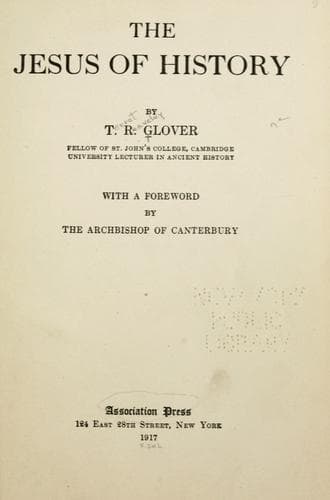
The Jesus of HistoryGlover, T. R. (Terrot Reaveley)
Religion
The Jesus of History
Glover, T. R. (Terrot Reaveley)
Jesus Christ -- Historicity
4. But have they gone? What resemblances are there between the world
to-day (in the West and in the East) and the problem of the Church
to-day and the Roman world and the problem of the Church then?
5. It was often remarked in India that, point by point, the writer's
description of religion in the Roman world is true to the letter of
Hinduism to-day. Work out this parallel. (See Dr J. N. Farquhar,
Crown of Hinduism and Modern Religious Movements in India.)
CHAPTER X
1. "It is the heart that makes the theologian." Where does
your theology come from?
2. The doctrine of the Atonement has often been stated as an attempt
to reconcile Jesus and an un-Christian conception of God.
"God was in Christ reconciling the world unto Himself." "The Cross
is the revelation in time of what God is always." Discuss.
3. What are the three ways of answering the question:
"Who and what is this Jesus Christ?" Why must people make up their
minds about him?
4. Does the writer make Jesus too human? Or has the reading of this
book made you feel his divinity more strongly just because he was so
perfectly human?
FOOTNOTES
[1] The Conflict of Religions in the Early Roman Empire, p. 157.
[2] "We are nothing; Christ alone is all."
[3] Canon Streeter in Foundations
[4] Cf. the foreigner's touch at Athens (Acts 17:21).
[5] because, later on, the Sabbath and Jewish ceremony were not among
the most living issues, after the Church had come to be chiefly
Gentile.
[6] On this point see R. W. Dale, "The Living Christ and the Four
Gospels"; and W. Sanday, "The Gospels in the Second Century."
[7] The reader will see that I am referring to Bishop Lightfoot's
article on "The Brethren of the Lord" in his commentary on
"Galatians", but not accepting his conclusions.
[8] That this is not quite fanciful is shown by the emphasis laid by
more or less contemporary writers on the increased facilities for
travel which the Roman Empire gave, and the use made of them.
[9] Wordsworth, Prelude, i. 586.
[10] Cf., F. G. Peabody, "Jesus Christ and Christian Character", pp.
57-60.
[11] H. S. Coffin, Creed of Jesus. pp. 240-242.
[12] "Prelude" xiii. 26 ff.
[13] See further, on this, in Chapter VII., p.168
[14] E.g., in his essay on "Mirabeau": "The real quantity of our
insight ... depends on our patience, our fairness, lovingness"; and
in "Biography": "A loving heart is the beginning of all knowledge."
[15] Cf. Deissmann, Light from the Ancient East, p. 154. I have
omitted one or two less relevant clauses--e.g. greetings to friends.
[16] Horace, "Epistles", i. 16, 48.
[17] Homer, "Odyssey", xvii. 322.
[18] It is only about four times that personal immortality comes with
any clearness in the Old Testament: Psalms 72 and 139; Isaiah 26;
and Job 16:26.
Public-domain text, read in full here on John Shaqi.
Reviews
Reviews
No reviews yet
Be the first to share your thoughts on this work.
Elsewhere in the archive
Join the Discussion
Join the discussion
Sign in to leave a comment or review.
Sign InorCreate an account