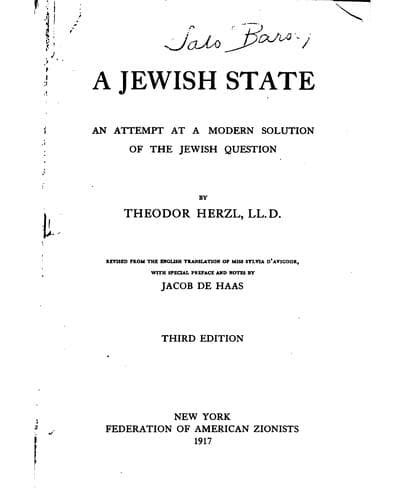
Herzl, Theodor, 1860-1904; Zionism; Zionists -- Austria -- Biography
He threw himself seriously and diligently into the journalistic craft.
He observed with close attention all that went on about him, and
listened with sharpened ears. But the moment had not yet come for the
unveiling of a mission within him. He was on the way; the process of
preparation had begun.
How, in this mood of his, could he possibly have avoided clashing with
the Jewish question? As far back as the time of his Spanish journey,
when he had sought healing from his domestic and spiritual torments,
the question had presented itself to him and had cried for artistic
expression. His call to Paris had been a welcome pretext, perhaps,
putting off the writing of his Jewish novel--the more so as he
probably was not ripe enough for such an undertaking. Now that he was
in Paris, where his eyes were opened to the full range of the social
process, he began to draw nearer in spirit to his fellow-Jews, and to
look upon them more warmly and with less inhibition. He found them as
difficult aesthetically as before, but he tried hard to grasp the
essence of their character and substance, and to judge them without
prejudice.
When Herzl arrived in Paris anti-Semitism, had not--in spite of
Drumont's exertions, and in spite of his paper, _la Libre Parole_,
founded in 1892--achieved the dimensions of a genuine movement, nor
was it destined to become one in the German sense. But it served as
the focus for all kinds of discontents and resentments; it attracted
certain serious critical spirits, too; its influence grew from day to
day, and the position of the Jews became increasingly uncomfortable.
Herzl's contact with anti-Semitism dated back to his student days,
when it had first taken on the form of a social political movement. He
had been aware of it as a writer, though the contact had never ripened
into a serious inner struggle or compelled him to give utterance to
it.
Now he read Drumont, as he had read Duehring. The impression was again
a profound one. What moved him most in the work was the totality of a
world picture based on a considered hostility to the Jews.
A ritual-murder trial was in progress in the town of Xanten, in the
Rhineland. On August 31, 1892, Herzl, dealing with this subject as
with all other subjects of public interest, summed up the general
situation in a long report entitled "French anti-Semitism."
By now Herzl was no longer content with a simple acceptance of the
facts; he was looking for the deeper significance of the universal
enmity directed against the Jews. For the world it is a lightning
conductor. But so far it was only a flash of insight which ended in
nothing more than a literary paradox. However, from now on it gave him
no peace.
Public-domain text, read in full here on John Shaqi.
Reviews
Reviews
No reviews yet
Be the first to share your thoughts on this work.
Join the Discussion
Join the discussion
Sign in to leave a comment or review.
Sign InorCreate an account