Herzl, Theodor, 1860-1904; Zionism; Zionists -- Austria -- Biography
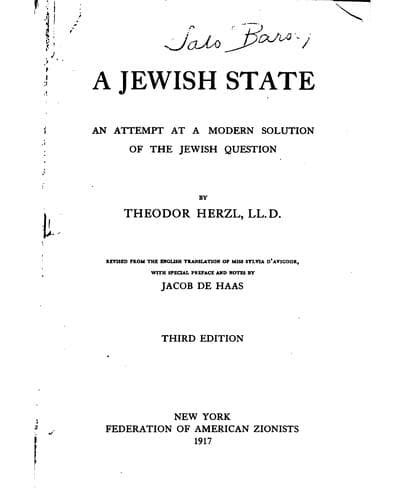
It was upon the Jewish masses that Herzl made a tremendous impression.
He dawned upon Jews of Eastern Europe as a mystic figure rising out of
the past. Little was known of his pamphlet, for it was kept out of the
country by censorship in Russia. Only its title got their attention
and the stories told of Herzl--the Western Jew returning to his
people--gripped their hearts and stirred their imagination. He was
greeted by one of the Galician Zionist societies as the leader who,
like Moses, had returned from Midian to liberate the Jews. Max Nordau,
that devastating critic of art and literature, was swept off his feet
and described the pamphlet as a revelation, Richard Beer Hoffman, the
poet, wrote to Herzl saying "At last there comes again a man, who does
not carry his Judaism with resignation as if it were a burden or a
misfortune, but is proud to be the legal heir of an immemorial
culture."
It became clear to Herzl that he would have to take an active part in
the task he had set forth in "The Jewish State." He no longer felt
that he stood alone. He was not inclined to appear on a public
platform. He had the shyness of the man who had always written what he
had to say. He also felt that it would do more harm than good if his
ideas were to be obscured by his personal presence. Through
correspondence he set in motion Zionist activities--in London, in
Paris, in Berlin, in the United States. The amount of letter-writing
he developed was enormous.
He decided that there were three tasks to be undertaken at once. The
first was the organization of the Society of Jews. The second was to
continue diplomatic work in Constantinople and among interested
Powers. The third was the creation of a press to influence public
opinion and to prepare the Jewish masses for the great migration.
Through the Rev. Hechler, a chaplain of the British Embassy in Vienna,
who believed in the Jewish return to the Holy Land, Herzl was
introduced to the Grand Duke of Baden, a Christian of great piety and
influence in political circles.
Herzl intended to use the influence of the Germans to affect the
Sultan and make him more sympathetic to Zionist proposals. Herzl told
the Grand Duke that he would like to have Zionism included within the
cultural sphere of German interests. The Grand Duke said that the
Kaiser seemed inclined to take Jewish migration under German
protection. The great powers were interested in maintaining certain
extra territorial rights within the Turkish Empire. If they had
nationals in any part of the Empire, they claimed the right to protect
them over and above Turkish law. It was, therefore, not the Kaiser's
interest in the Jews, but in extending German jurisdiction within the
Turkish Empire that persuaded him to suggest the adoption of Jews in
Palestine for that purpose. Germany had a special relationship to
Turkey. Most of the western powers were openly discussing the
impending partition of the Turkish Empire, but Germany was opposed to
it.
Public-domain text, read in full here on John Shaqi.
Reviews
Reviews
No reviews yet
Be the first to share your thoughts on this work.
Join the Discussion
Join the discussion
Sign in to leave a comment or review.
Sign InorCreate an account