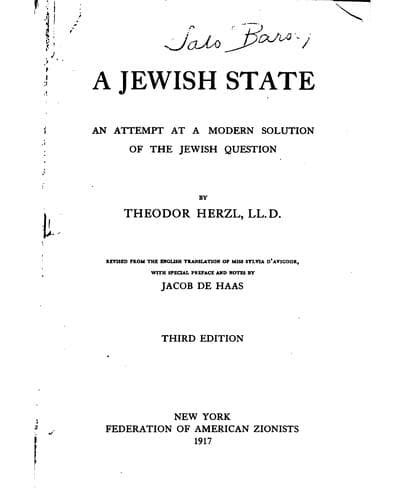
Herzl, Theodor, 1860-1904; Zionism; Zionists -- Austria -- Biography
At this point it is important to refer to his family life. He had
married Julie Naschauer on July 25, 1889. She was the daughter of
wealthy parents and grew up in a conventional social circle. When she
married Herzl he was already a rising young author who was highly
regarded among those with whom she associated. He was attractive,
aristocratic in bearing, a keen conversationalist and had all the
qualities of being a conventional partner of a conventional wife. But
Herzl threw himself into Zionist affairs with such tremendous dynamic
activity and was so completely absorbed in the idea which his thinking
had given birth to, that except for occasional interim periods, his
family played a secondary part in his life ever after he had taken up
the Jewish problems his special task in life. Julie Herzl also
suffered by reason of Herzl's devotion to his own mother. Herzl never
rid himself of his filial dependence which made it very hard for his
wife to understand. They had three children. In 1890 a daughter was
born and named Paula or Pauline. In 1891 his son, Hans, was born,
whose life after his father's death became a serious problem. There
was a third child, a daughter Margaret, known as Trude, who was born
in May 1893. During this period there were many separations from his
family. There were disagreements and reconciliations, but the cup of
unhappiness for Julie Herzl overflowed when Herzl became the official
leader of a public movement. From that time on her home was constantly
overrun with unwelcome visitors. Not only did Herzl give his life to
the movement in the literal sense, but he gave his reserve of funds
and sacrificed the welfare of his family for the sake of the movement
he had brought to life. His domestic affairs as well as his failing
heart, made all the years of Herzl's brief Zionist life pain and
struggle.
The tragic position of Jews in various parts of Europe, greatly
agitated Herzl during the time he was carrying on negotiations with
the Kaiser and the Sultan. He was constantly being led to the thought
that it would become necessary to find a temporary haven of refuge for
Jews. In 1899 a series of pogroms broke out in Galicia. In his diary
at the time, he had references to England and Cyprus, "we may even
have to consider South Africa or America." But he banished these
thoughts from his mind because he knew that the Zionists would place
serious obstacles in the way of considering any project other than
Palestine. When his hopes with regard to Germany had collapsed,
however, he thought of these alternative proposals again.
* * * * *
Public-domain text, read in full here on John Shaqi.
Reviews
Reviews
No reviews yet
Be the first to share your thoughts on this work.
Join the Discussion
Join the discussion
Sign in to leave a comment or review.
Sign InorCreate an account