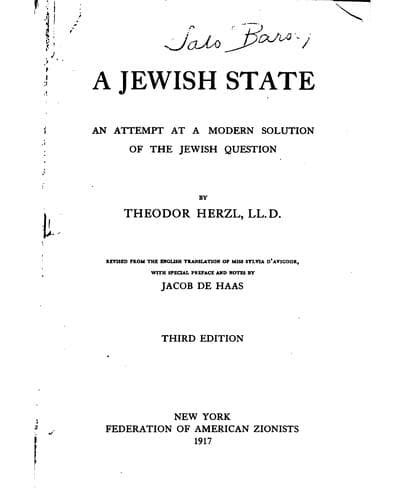
Herzl, Theodor, 1860-1904; Zionism; Zionists -- Austria -- Biography
Lord Lansdowne also touched on the question of the new citizenship of
the settlers. Herzl had believed that he would have only Englishmen to
deal with, since England had become more and more the master of Egypt.
It was apparent, however, that the Egyptian Government also played an
important part in the discussions.
Lord Cromer confirmed that the Egyptian Government would make it an
essential condition that the new settlers become Turkish subjects
bound by Egyptian law, but while the British occupation continued the
settlers would always be certain of fair treatment.
Herzl was satisfied with this letter and described it as a historic
document. The British Government had recognized Herzl as the Zionist
leader, and the movement represented by him as a negotiating party. He
already saw the "Egyptian province of Judea" under a Jewish Governor,
with its own defense corps under Anglo-Egyptian officers.
As a result of the English negotiations, Lord Rothschild seemed to be
won over by Herzl. The old banker, who had refused two years before to
meet the Zionist leader, now visited him in his hotel. The next task
before Herzl was the organization of the Commission. The Commission
was composed of the South African engineer, Kessler; the Chief
Inspector of the Egyptian Survey Department, Humphreys; Col. Goldsmith
was to report on the land; and Dr. Soskin was to study agricultural
possibilities. Oscar Marmorek was to investigate building and housing
problems and act as General Secretary. Dr. Hillel Jaffe of the Jaffe
Hospital was to deal with the problems of climate and hygiene.
The Commission met with great difficulties. There was opposition by
the Turks. There was misunderstandings between Herzl and Greenberg.
Herzl himself went to Egypt in order to bring the negotiations to a
conclusion and to straighten out difficulties. His intervention in no
way improved the situation. Lord Cromer had become very cool toward
him. He received the general report of the Commission, which observed
that "under existing conditions the land is quite unsuitable for
settlers from European countries, but if sufficient irrigation were
introduced, the agricultural, hygienic and climatic conditions are
such that part of the land, which is at present wilderness, could
support a considerable population."
An application for the concession was made by Herzl on the advice of
Lord Cromer, having as his legal representative a Belgian lawyer of
high standing. The Egyptian Government did not receive with favor the
outline of the concession. Herzl was received on April 23rd by
Chamberlain, who had just returned from his African journey.
Chamberlain listened to the report given by Herzl on the work of the
Commission. Both regarded the report as unfavorable. Then Chamberlain
made this remark:
Public-domain text, read in full here on John Shaqi.
Reviews
Reviews
No reviews yet
Be the first to share your thoughts on this work.
Join the Discussion
Join the discussion
Sign in to leave a comment or review.
Sign InorCreate an account