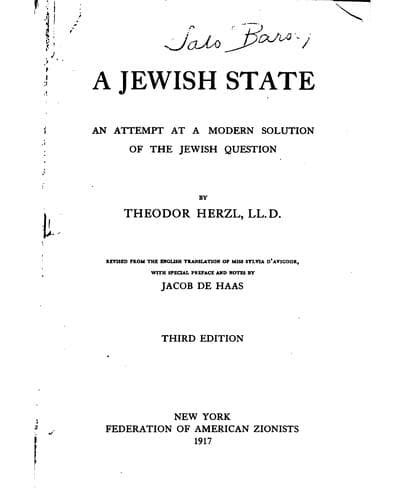
Herzl, Theodor, 1860-1904; Zionism; Zionists -- Austria -- Biography
Rich Jews who are now obliged carefully to secrete their valuables,
and to hold their dreary banquets behind lowered curtains, will be
able to enjoy their possessions in peace, "over there." If they
cooperate in carrying out this emigration scheme, their capital will
be rehabilitated and will have served to promote an unexampled
undertaking. If in the new settlement rich Jews begin to rebuild their
mansions which are stared at in Europe with such envious eyes, it will
soon become fashionable to live over there in beautiful modern houses.
SOME FORMS OF LIQUIDATION
The Jewish Company is intended to be the receiver and administrator of
the non-transferable goods of the Jews.
Its methods of procedure can be easily imagined in the case of houses
and estates, but what methods will it adopt in the transfer of
businesses?
Here numberless processes may be found practicable, which cannot all
be enlarged on in this outline. But none of them will present any
great difficulties, for in each case the business proprietor, when he
voluntarily decides to emigrate, will settle with the Company's
officers in his district on the most advantageous form of
liquidation.
This will most easily be arranged in the case of small employers, in
whose trades the personal activity of the proprietor is of chief
importance, while goods and organization are a secondary
consideration. The Company will provide a certain field of operation
for the emigrant's personal activity, and will substitute a piece of
ground, with loan of machinery, for his goods. Jews are known to adapt
themselves with remarkable ease to any form of earning a livelihood,
and they will quickly learn to carry on a new industry. In this way a
number of small traders will become small landholders. The Company
will, in fact, be prepared to sustain what appears to be a loss in
taking over the non-transferable property of the poorest emigrants;
for it will thereby induce the free cultivation of tracts of land,
which raises the value of adjacent tracts.
In medium-sized businesses, where goods and organization equal, or
even exceed, in importance, the personal activity of the manager,
whose larger connection is also non-transferable, various forms of
liquidation are possible. Here comes an opportunity for that inner
migration of Christian citizens into positions evacuated by Jews. The
departing Jew will not lose his personal business credit, but will
carry it with him, and make good use of it in a new country to
establish himself. The Jewish Company will open a current bank account
for him. And he can sell the goodwill of his original business, or
hand it over to the control of managers under supervision of the
Company's officials. The managers may rent the business or buy it,
paying for it by instalments. But the Company acts temporarily as
curator for the emigrants, in superintending, through its officers and
lawyers, the administration of their affairs, and seeing to the proper
collection of all payments.
Public-domain text, read in full here on John Shaqi.
Reviews
Reviews
No reviews yet
Be the first to share your thoughts on this work.
Elsewhere in the archive
Join the Discussion
Join the discussion
Sign in to leave a comment or review.
Sign InorCreate an account