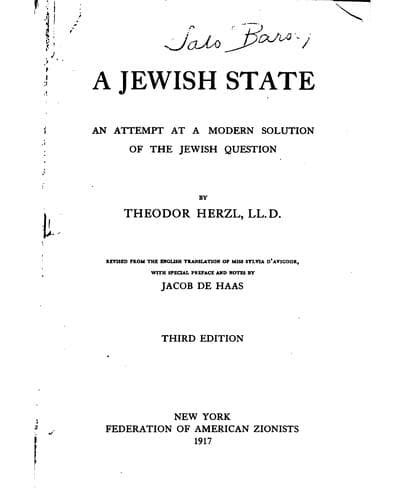
Herzl, Theodor, 1860-1904; Zionism; Zionists -- Austria -- Biography
If a Jew cannot sell his business, or entrust it to a proxy or wish to
give up its personal management, he may stay where he is. The Jews who
stay will be none the worse off, for they will be relieved of the
competition of those who leave, and will no longer hear the
Anti-Semitic cry: "Don't buy from Jews!"
If the emigrating business proprietor wishes to carry on his old
business in the new country, he can make his arrangements for it from
the very commencement. An example will best illustrate my meaning. The
firm X carries on a large business in dry goods. The head of the firm
wishes to emigrate. He begins by setting up a branch establishment in
his future place of residence, and sending out samples of his stock.
The first poor settlers will be his first customers; these will be
followed by emigrants of a higher class, who require superior goods. X
then sends out newer goods, and eventually ships his newest. The
branch establishment begins to pay while the principal one is still in
existence, so that X ends by having two paying business-houses. He
sells his original business or hands it over to his Christian
representative to manage, and goes off to take charge of the new one.
Another and greater example: Y and Son are large coal-traders, with
mines and factories of their own. How is so huge and complex a
property to be liquidated? The mines and everything connected with
them might, in the first place, be bought up by the State, in which
they are situated. In the second place, the Jewish Company might take
them over, paying for them partly in land, partly in cash. A third
method might be the conversion of "Y and Son" into a limited company.
A fourth method might be the continued working of the business under
the original proprietors, who would return at intervals to inspect
their property, as foreigners, and as such, under the protection of
law in every civilized State. All these suggestions are carried out
daily. A fifth and excellent method, and one which might be
particularly profitable, I shall merely indicate, because the existing
examples of its working are at present few, however ready the modern
consciousness may be to adopt them. Y and Son might sell their
enterprise to the collective body of their employees, who would form a
cooperative society, with limited liability, and might perhaps pay the
requisite sum with the help of the State Treasury, which does not
charge high interest.
The employees would then gradually pay off the loan, which either the
Government or the Jewish Company, or even Y and Son, would have
advanced to them.
Public-domain text, read in full here on John Shaqi.
Reviews
Reviews
No reviews yet
Be the first to share your thoughts on this work.
Elsewhere in the archive
Join the Discussion
Join the discussion
Sign in to leave a comment or review.
Sign InorCreate an account