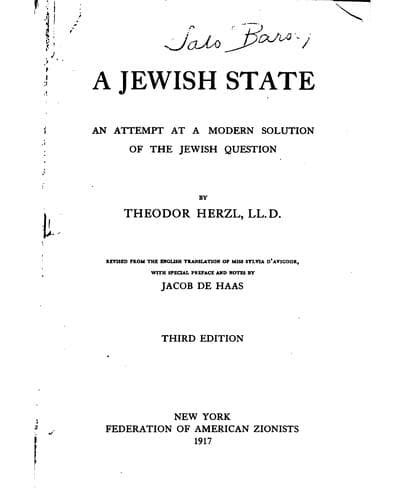
Herzl, Theodor, 1860-1904; Zionism; Zionists -- Austria -- Biography
Here certain limited notions must be set aside. Whoever has seen
anything of the world knows that just these little daily customs can
easily be transplanted everywhere. The technical contrivances of our
day, which this scheme intends to employ in the service of humanity,
have heretofore been principally used for our little habits. There are
English hotels in Egypt and on the mountain-crest in Switzerland,
Vienna cafes in South Africa, French theatres in Russia, German operas
in America, and best Bavarian beer in Paris.
When we journey out of Egypt again we shall not leave the fleshpots
behind.
Every man will find his customs again in the local groups, but they
will be better, more beautiful, and more agreeable than before.
_V. Society of Jews and Jewish State_
NEGOTIORUM GESTIO
This pamphlet is not intended for lawyers. I can therefore touch only
cursorily, as on so many other things, upon my theory of the legal
basis of a State.
I must, nevertheless, lay some stress on my new theory, which could be
maintained, I believe, even in discussion with men well versed in
jurisprudence.
According to Rousseau's now antiquated view, a State is formed by a
social contract. Rousseau held that: "The conditions of this contract
are so precisely defined by the nature of the agreement that the
slightest alteration would make them null and void. The consequence is
that, even where they are not expressly stated, they are everywhere
identical, and everywhere tacitly accepted and recognized," etc.
A logical and historic refutation of Rousseau's theory was never, nor
is now, difficult, however terrible and far-reaching its effects may
have been. The question whether a social contract with "conditions not
expressly stated, yet unalterable," existed before the framing of a
constitution, is of no practical interest to States under modern forms
of government. The legal relationship between government and citizen
is in any case clearly established now.
But previous to the framing of a constitution, and during the creation
of a new State, these principles assume great practical importance. We
know and see for ourselves that States still continue to be created.
Colonies secede from the mother country. Vassals fall away from their
suzerain; newly opened territories are immediately formed into free
States. It is true that the Jewish State is conceived as a peculiarly
modern structure on unspecified territory. But a State is formed, not
by pieces of land, but rather by a number of men united under
sovereign rule.
The people is the subjective, land the objective foundation of a
State, and the subjective basis is the more important of the two. One
sovereignty, for example, which has no objective basis at all, is
perhaps the most respected one in the world. I refer to the
sovereignty of the Pope.
Public-domain text, read in full here on John Shaqi.
Reviews
Reviews
No reviews yet
Be the first to share your thoughts on this work.
Elsewhere in the archive
Join the Discussion
Join the discussion
Sign in to leave a comment or review.
Sign InorCreate an account