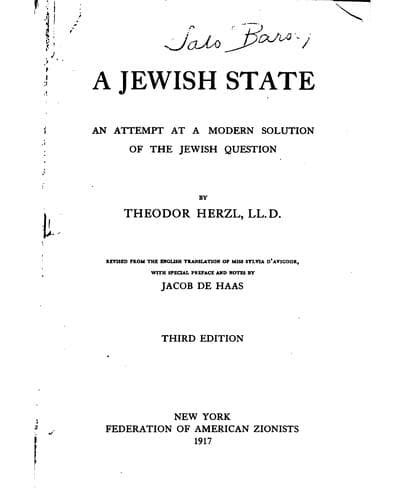
Herzl, Theodor, 1860-1904; Zionism; Zionists -- Austria -- Biography
The theory of rationality is the one at present accepted in political
science. This theory suffices to justify the creation of a State, and
cannot be historically refuted in the same way as the theory of a
contract. Insofar as I am concerned only with the creation of a Jewish
State, I am well within the limits of the theory of rationality. But
when I touch upon the legal basis of the State, I have exceeded them.
The theories of a divine institution, or of superior power, or of a
contract, and the patriarchal and patrimonial theories do not accord
with modern views. The legal basis of a State is sought either too
much within men (patriarchal theory, and theories of superior force
and contract), or too far above them (divine institution), or too far
below them (objective patrimonial theory). The theory of rationality
leaves this question conveniently and carefully unanswered. But a
question which has seriously occupied doctors of jurisprudence in
every age cannot be an absolutely idle one. As a matter of fact, a
mixture of human and superhuman goes to the making of a State. Some
legal basis is indispensable to explain the somewhat oppressive
relationship in which subjects occasionally stand to rulers. I believe
it is to be found in the _negotiorum gestio_, wherein the body of
citizens represents the _dominus negotiorum_, and the government
represents the _gestor_.
The Romans, with their marvellous sense of justice, produced that
noble masterpiece, the _negotiorum gestio_. When the property of an
oppressed person is in danger, any man may step forward to save it.
This man is the _gestor_, the director of affairs not strictly his
own. He has received no warrant--that is, no human warrant; higher
obligations authorize him to act. The higher obligations may be
formulated in different ways for the State, and so as to respond to
individual degrees of culture attained by a growing general power of
comprehension. The _gestio_ is intended to work for the good of the
_dominus_--the people, to whom the _gestor_ himself belongs.
The _gestor_ administers property of which he is joint-owner. His
joint proprietorship teaches him what urgency would warrant his
intervention, and would demand his leadership in peace or war; but
under no circumstances is his authority valid _qua_ joint
proprietorship. The consent of the numerous joint-owners is even under
most favorable conditions a matter of conjecture.
A State is created by a nation's struggle for existence. In any such
struggle it is impossible to obtain proper authority in circumstantial
fashion beforehand. In fact, any previous attempt to obtain a regular
decision from the majority would probably ruin the undertaking from
the outset. For internal schisms would make the people defenceless
against external dangers. We cannot all be of one mind; the _gestor_
will therefore simply take the leadership into his hands and march in
the van.
Public-domain text, read in full here on John Shaqi.
Reviews
Reviews
No reviews yet
Be the first to share your thoughts on this work.
Elsewhere in the archive
Join the Discussion
Join the discussion
Sign in to leave a comment or review.
Sign InorCreate an account