Scotland -- Social life and customs -- 19th century -- Fiction
E-text prepared by Suzanne Shell, Martin Pettit, and the Project Gutenberg
Online Distributed Proofreading Team (https://www.pgdp.net)
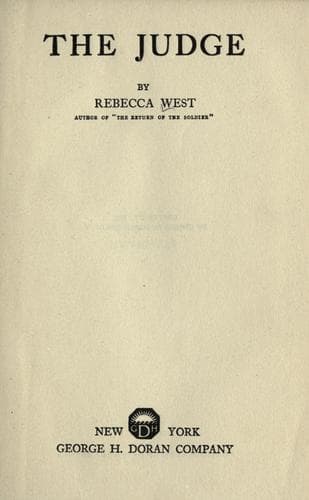
THE JUDGE
by
REBECCA WEST
Author of "The Return Of The Soldier"
New York
George H. Doran Company
1922,
TO
THE MEMORY OF
MY MOTHER
BOOK ONE
"Every mother is a judge who sentences the children for the sins of
the father."
CHAPTER I
I
It was not because life was not good enough that Ellen Melville was
crying as she sat by the window. The world, indeed, even so much of it
as could be seen from her window, was extravagantly beautiful. The
office of Mr. Mactavish James, Writer to the Signet, was in one of those
decent grey streets that lie high on the northward slope of Edinburgh
New Town, and Ellen was looking up the side-street that opened just
opposite and revealed, menacing as the rattle of spears, the black rock
and bastions of the Castle against the white beamless glare of the
southern sky. And it was the hour of the clear Edinburgh twilight, that
strange time when the world seems to have forgotten the sun though it
keeps its colour; it could still be seen that the moss between the
cobblestones was a wet bright green, and that a red autumn had been busy
with the wind-nipped trees, yet these things were not gay, but cold and
remote as brightness might be on the bed of a deep stream, fathoms
beneath the visitation of the sun. At this time all the town was
ghostly, and she loved it so. She took her mind by the arm and marched
it up and down among the sights of Edinburgh, telling it that to be
weeping with discontent in such a place was a scandalous turning up of
the nose at good mercies. Now the Castle Esplanade, that all day had
proudly supported the harsh, virile sounds and colours of the drilling
regiments, would show to the slums its blank surface, bleached
bone-white by the winds that raced above the city smoke. Now the Cowgate
and the Canongate would be given over to the drama of the disorderly
night; the slum-dwellers would foregather about the rotting doors of
dead men's mansions and brawl among the not less brawling ghosts of a
past that here never speaks of peace, but only of blood and argument.
And Holyrood, under a black bank surmounted by a low bitten cliff, would
lie like the camp of an invading and terrified army.... She stopped and
said, "Yon about Holyrood's a fine image for the institution of
monarchy." For she was a Suffragette, so far as it is possible to be a
Suffragette effectively when one is just seventeen, and she spent much
of her time composing speeches which she knew she would always be too
shy to deliver. "There is a sinister air about palaces. Always they
appear like the camp of an invading army that is uneasy and keeps a good
look-out lest they need shoot. Remember they are always ready to
shoot...." She interrupted herself with a click of annoyance. "I see
myself standing on a herring-barrel and trying to hold the crowd with
the like of that.
Public-domain text, read in full here on John Shaqi.
Reviews
Reviews
No reviews yet
Be the first to share your thoughts on this work.
Join the Discussion
Join the discussion
Sign in to leave a comment or review.
Sign InorCreate an account